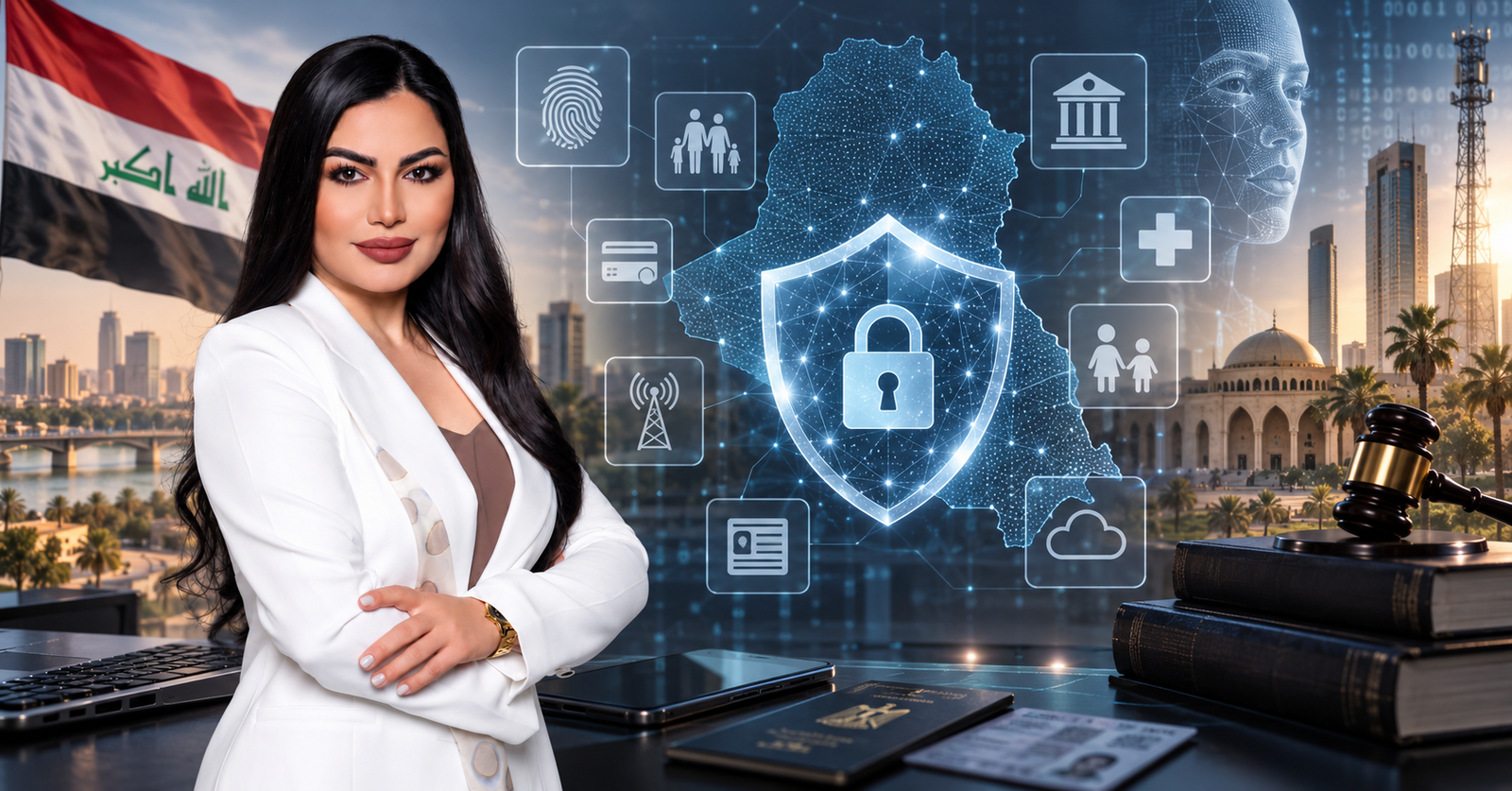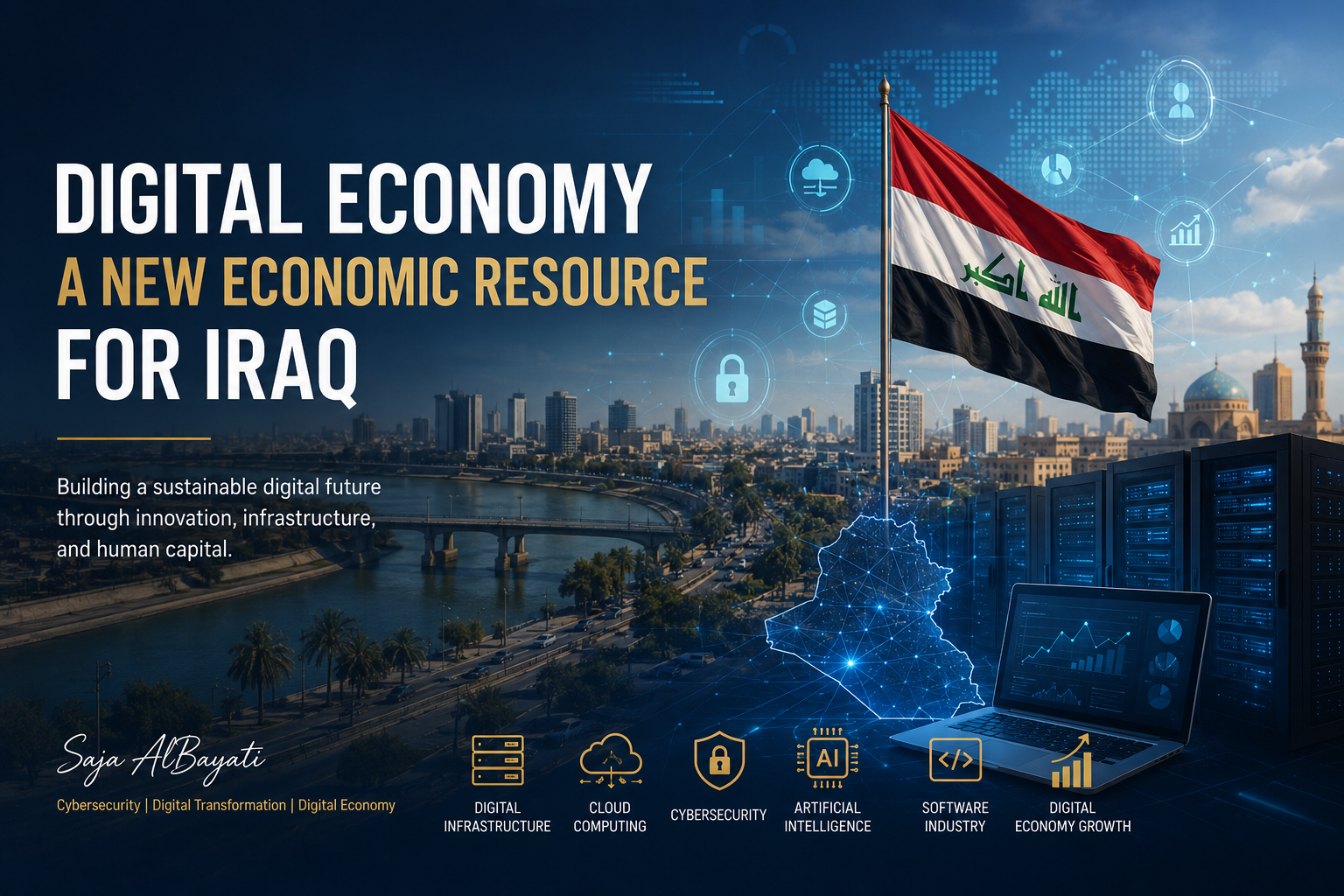

Cybersecurity today is no longer merely a technical matter confined to information technology departments, nor is it limited to protecting computers from intrusion or installing security software.
We are dealing with a far broader concept.
As governments increasingly shift toward digital services, institutions become more dependent on databases and digital platforms, and electronic payments, banking services, telecommunications, artificial intelligence, and cloud computing continue to expand, protecting cyberspace becomes an integral part of protecting the state itself.
Therefore, the question Iraq must ask is no longer simply:
How do we protect our systems from cyberattacks?
The more important question is:
How do we build a digital state capable of protecting its data, institutions, economy, citizens, critical infrastructure, and digital sovereignty?
In my view, this shift in thinking represents the true starting point for building a national cybersecurity ecosystem capable of keeping pace with global technological transformation.
What Is Cybersecurity, and Why Has It Become a Matter of National Importance?
Cybersecurity is an integrated system of policies, technologies, procedures, human capabilities, and legislation designed to protect systems, networks, data, and digital services against intrusion, disruption, theft, sabotage, and unauthorized use.
At the national level, however, cybersecurity extends far beyond this technical definition.
As government services become digital, government data becomes a strategic national asset.
Citizens’ databases are national assets.
Financial and banking systems are national assets.
Telecommunications networks are national assets.
Government and ministerial systems are national assets.
Energy, transportation, and public-service infrastructure are national assets.
Digital platforms that provide public services have become part of the essential infrastructure of the modern state.
Cybersecurity, therefore, is not an obstacle to digital transformation. It is one of the fundamental conditions for its success.
A truly digital state cannot be built without first building a digitally secure state.
Where Does Iraq Stand Today?
It would be inaccurate to say that Iraq has not begun its cybersecurity journey. It would be equally inaccurate to suggest that the country has already reached the level to which it aspires.
Iraq has taken tangible steps toward developing institutions, capabilities, and initiatives in this field. One of the most significant developments has been the establishment and growing role of the National Cybersecurity Center, whose objectives include protecting critical infrastructure and government institutions, developing national capabilities, promoting cybersecurity awareness and culture, and strengthening domestic and international partnerships.
International indicators, however, provide a clearer picture of the distance that remains to be covered.
In the fifth edition of the ITU Global Cybersecurity Index (GCI) 2024, Iraq was classified in Tier 4 – Evolving, reflecting a country that has established cybersecurity efforts and commitments but whose overall cybersecurity ecosystem remains under development.
The index evaluates national cybersecurity commitment across five core pillars:
Legal Measures, Technical Measures, Organizational Measures, Capacity Development, and Cooperation.
Improving Iraq’s cybersecurity position, therefore, cannot be achieved simply by purchasing advanced security technologies. It requires the development of a comprehensive national ecosystem addressing all of these dimensions.
What Has Iraq Achieved?
When assessing Iraq’s cybersecurity landscape, it is important not to focus exclusively on weaknesses.
There has been a noticeable shift in the level of official attention given to cybersecurity compared with previous years.
The presence of a specialized national cybersecurity authority represents an important institutional step.
Cybersecurity itself is also gradually moving beyond being viewed as a narrow technical issue and is increasingly being recognized as a matter connected to national security and digital transformation.
There is growing attention to system and network assessments, vulnerability identification, risk management, human-capacity development, awareness, and cooperation among different institutions.
The National Cybersecurity Center identifies the protection of national cyberspace, capability development, cybersecurity awareness, and the provision of specialized services to the public and private sectors among its areas of focus.
These are positive developments upon which Iraq can build.
However, moving from individual initiatives toward a mature and integrated national cybersecurity ecosystem requires a new stage of coordinated action.
Challenge One: Moving from Reactive to Proactive Cybersecurity
One of the most important transformations Iraq needs is a change in the philosophy of cybersecurity itself.
Under the traditional model, an incident occurs first and the institution then begins searching for a solution.
Modern cybersecurity takes a different approach:
Anticipate. Prevent. Detect. Respond. Recover. Learn.
Organizations must operate under the assumption that threats exist and that a breach is possible.
The question should therefore not be:
Will we be attacked?
It should be:
When might an attack occur, and will we be prepared when it does?
This is why incident-response plans, risk management, secure backups, business continuity, disaster recovery, continuous monitoring, and cybersecurity-readiness exercises are essential components of a modern security strategy.
Challenge Two: Protecting Critical Infrastructure
The most dangerous cyberattacks are not necessarily those targeting individual accounts.
At the national level, the greater threat lies in attacks against critical infrastructure.
This includes sectors such as electricity and energy, oil and gas, banking, telecommunications, transportation, healthcare institutions, government systems, water and essential services, and financial infrastructure.
The disruption of a simple digital service may cause inconvenience.
The disruption of critical infrastructure, however, can evolve into an economic, public-service, or national-security crisis.
Iraq therefore needs to clearly identify its Critical Infrastructure, classify systems according to their sensitivity and strategic importance, and establish mandatory cybersecurity requirements proportionate to the level of risk.
Challenge Three: Data and Digital Sovereignty
One of the issues I believe will become increasingly critical for Iraq in the coming years is digital sovereignty.
Where is Iraqi data stored?
Who manages it?
Who has access to it?
How strongly is it encrypted?
Where are backup copies stored?
Which jurisdictions and laws apply when sensitive data is hosted outside Iraq?
And what happens if the state becomes entirely dependent on foreign infrastructure or technologies for strategically important services?
Digital sovereignty does not mean isolating Iraq from the world or rejecting global technology providers.
Rather, it means that the state understands where its sensitive digital assets are located, who controls them, and possesses the legal, technical, and institutional capacity required to protect and manage them.
National data centers, data-classification policies, encryption, digital identity and access management, and secure cloud computing must therefore be viewed as matters connected to national security—not merely as IT projects.
Challenge Four: The Human Factor
A country can purchase sophisticated hardware and advanced software, but it cannot simply purchase a ready-made security culture.
People remain a fundamental component of cybersecurity.
An employee may use a weak password.
A user may click a fraudulent link.
An employee may share sensitive information through an insecure channel.
An administrator may grant users more privileges than they actually require.
Any of these actions can undermine significant investments in technology and expose an otherwise advanced system to risk.
Cybersecurity training should therefore not be limited to security professionals.
Iraq needs different levels of training, beginning with ordinary employees and extending to system administrators, developers, senior executives, and policymakers.
Challenge Five: Digital Awareness Across Society
National cybersecurity does not begin and end with government institutions.
Citizens are part of the cybersecurity ecosystem.
Online fraud, identity theft, fake accounts, account takeovers, phishing, deepfakes, cyber extortion, and personal-data exposure are threats that increasingly affect society directly.
As artificial intelligence advances, generating convincing fake images, voices, and videos has become easier and more accessible.
This makes digital literacy an essential component of cybersecurity.
A digitally aware citizen represents an additional line of defense.
A society that lacks adequate digital awareness is more vulnerable to deception, fraud, manipulation, and exploitation.
Challenge Six: Legislation and Regulation
Technology evolves rapidly, and the legal environment must be capable of keeping pace.
Iraq needs a clear and integrated legislative framework addressing data protection and privacy, cybercrime, institutional responsibilities, incident reporting, digital evidence, the handling of sensitive data, artificial intelligence, and emerging technologies.
An important balance must also be maintained:
Protecting national security on one hand, while protecting citizens’ rights and privacy on the other.
True cybersecurity does not mean expanding surveillance without safeguards. It means creating a secure digital environment governed by clear, transparent, and accountable legal frameworks.
Challenge Seven: The Cybersecurity Skills Gap
Cybersecurity is an extremely broad field.
The country does not simply need people who understand basic security concepts.
It requires specialists in:
Network Security, Application Security, Cloud Security, Digital Forensics, Incident Response, Threat Intelligence, Risk Management, Governance and Compliance, Penetration Testing, Industrial and Operational Technology Security, AI Security, and Identity and Access Management.
Iraqi universities therefore need to move beyond purely theoretical education toward developing practical capabilities aligned with the real requirements of government institutions and the labor market.
Challenge Eight: The Gap Between Purchasing Technology and Building National Capability
There is a fundamental difference between a country possessing technology and a country possessing national digital capability.
An advanced system can be purchased.
But who will operate it?
Who will develop it?
Who will audit it?
Who will respond when something goes wrong?
And who ensures that the country does not become permanently dependent on a single technology provider?
Iraq’s objective should therefore not be limited to importing solutions.
The broader objective must include knowledge transfer, local expertise development, and the growth of Iraq’s domestic technology industry.
The Positive Impact of Cybersecurity and Digital Transformation
The benefits of building a strong cybersecurity ecosystem extend far beyond preventing cyberattacks.
Cybersecurity strengthens citizens’ trust in digital government services.
It enables institutions to expand their electronic services.
It supports banking, electronic payments, and e-commerce.
It creates a more trusted environment for companies and investors participating in the digital economy.
It helps protect intellectual property.
It creates new employment opportunities.
It also enables Iraq to expand more securely into artificial intelligence, cloud computing, the Internet of Things, and smart-city technologies.
For this reason, well-planned cybersecurity spending should not be viewed merely as a cost.
It is an investment in the digital economy.
Cybersecurity Is Also an Economic Issue
The global economy is becoming increasingly dependent on data, digital platforms, and online services.
As economies become more technology-dependent, digital trust becomes an economic asset.
Businesses are less likely to invest in digital environments where they cannot trust the protection of their data.
Likewise, citizens are less likely to fully adopt electronic services when they fear losing their money, identities, or personal information.
Cybersecurity has therefore become an integral part of the investment environment.
Iraq can also view cybersecurity as an economic opportunity.
Iraqi cybersecurity companies, Security Operations Centers, cloud-service providers, data centers, software developers, cybersecurity consultancies, and training providers could collectively develop into a significant industry—creating employment while reducing excessive dependence on imported solutions.
What Do Cybersecurity-Leading Countries Do Differently?
Countries with mature cybersecurity capabilities do not rely on a single program, product, or institution.
They build an integrated Cybersecurity Ecosystem.
They have national strategies.
They establish clear authorities for leadership and coordination.
They develop effective legislation.
They implement mandatory security standards.
They maintain incident-response capabilities.
They operate Security Operations Centers.
They invest continuously in skills and workforce development.
They create partnerships between government, universities, research institutions, and the private sector.
They establish mechanisms for international cooperation and information sharing.
And they continuously assess their cybersecurity readiness.
This is particularly important for Iraq:
Cybersecurity is not a project with an expiration date. It is a continuous process.
What Does Iraq Need to Reach the Level of Advanced Cybersecurity Nations?
In my view, Iraq needs a clear national roadmap for the next phase, built around a series of interconnected priorities.
First, Iraq should develop a unified national cybersecurity-readiness framework applicable across government institutions and critical sectors.
Second, institutions should undergo periodic cybersecurity maturity assessments rather than relying on one-time technical evaluations.
Third, critical infrastructure should be clearly identified and classified, with cybersecurity requirements established for each sector.
Fourth, national incident-response capabilities should be strengthened and relevant institutions connected through an effective coordination mechanism.
Fifth, Iraq should establish and strengthen Security Operations Centers (SOCs) capable of continuous monitoring, analysis, detection, and response.
Sixth, Zero Trust principles should be implemented progressively, ensuring that trust is never automatically granted to a user, device, or system.
Seventh, the use of Multi-Factor Authentication and effective Identity and Access Management should be expanded.
Eighth, Iraq needs a clear national policy for data classification and protection.
Ninth, advanced backup, disaster-recovery, and business-continuity policies should be developed and regularly tested.
Tenth, national programs should be established for professional cybersecurity training, certifications, and practical skills development.
Eleventh, cooperation between government, universities, research institutions, and the private sector must be strengthened.
Twelfth, Iraqi technology and cybersecurity companies should be supported as part of developing national capability.
Thirteenth, internationally recognized standards and frameworks, including the NIST Cybersecurity Framework and ISO/IEC 27001, should be adopted and adapted to Iraq’s institutional and operational environment.
Fourteenth, Iraq should develop a nationwide digital-awareness ecosystem that begins in schools and universities and extends across government institutions and society.
Artificial Intelligence Will Transform the Cybersecurity Equation
The future of cybersecurity in Iraq cannot be discussed without addressing artificial intelligence.
AI represents both an opportunity and a threat.
It can be used to analyze vast amounts of data, detect abnormal patterns, accelerate threat detection, and support security teams in investigating and responding to incidents.
At the same time, AI technologies can be misused to make fraud, phishing, social engineering, impersonation, and deepfake content increasingly sophisticated and convincing.
The next phase therefore requires Iraq to pursue two objectives simultaneously:
Securing artificial intelligence and using artificial intelligence to strengthen cybersecurity.
Eng. Saja Albayati’s Vision
I believe Iraq has a genuine opportunity to move beyond treating cybersecurity as merely a technical requirement and begin recognizing it as one of the fundamental pillars of the digital state.
I do not believe the solution lies in simply replicating another country’s model.
Iraq needs a model designed around its own institutional, economic, technological, and societal realities.
My vision is based on building a smart and integrated Iraqi framework for cybersecurity readiness and digital sovereignty—one that connects technology, people, institutions, legislation, governance, and the economy.
Such a framework should not measure cybersecurity merely by counting the number of security systems deployed within an institution.
It should measure the institution’s actual resilience and readiness.
Does the institution know what digital assets it owns?
Does it understand its risks?
Does it know who has access to sensitive data?
Can it detect an attack?
How quickly can it respond?
Can it continue delivering essential services during a cyber incident?
Can it recover its systems effectively?
Are its personnel adequately trained?
Does it learn from previous incidents?
These are the questions that determine genuine cybersecurity readiness.
I also believe Iraq should develop a National Cybersecurity Readiness Index that enables institutions and sectors to be assessed periodically, transforming cybersecurity readiness from a broad concept into measurable indicators that can be monitored, compared, and continuously improved.
From Cybersecurity to Digital Sovereignty
The ultimate objective should not simply be preventing cyberattacks.
The broader goal should be building Iraqi digital sovereignty.
This means developing Iraq’s capacity to manage and protect its strategic digital assets, strengthen its human capital, build resilient infrastructure, and make technological decisions in accordance with its national interests.
Digital sovereignty does not mean disconnecting from global technology.
Quite the opposite.
A digitally sovereign state can cooperate more effectively with the international community because it understands what it owns, what must be protected, what can be shared, and what must remain under national control.
Cybersecurity Is a Shared Responsibility
Government cannot build national cybersecurity alone.
Neither can the private sector.
Universities cannot do it alone.
Nor can citizens.
Iraq needs a collaborative model that brings together:
Government, the private sector, universities, research centers, cybersecurity experts, civil-society organizations, and citizens.
Every stakeholder represents part of the solution.
Iraq Faces an Opportunity, Not Only a Challenge
Discussions about weaknesses should not create an unnecessarily pessimistic picture.
Iraq has a large young population, growing interest in technology, expanding digital services, and Iraqi expertise both inside the country and abroad.
These factors can be transformed into national strengths.
Doing so, however, requires a transition from isolated initiatives toward a long-term national program for building digital and cybersecurity capabilities.
Iraq also has an opportunity to accelerate its progress by learning from international experiences without having to repeat every mistake made during other countries’ digital transformation journeys.
From Protecting Devices to Protecting the Future
Modern cybersecurity is no longer simply a battle over hardware and software.
It is a battle over data.
It is a battle over economic resilience.
It is a battle over knowledge.
It is a battle over trust.
And ultimately, it is a matter of sovereignty.
We must therefore stop treating cybersecurity as the department we turn to only after something has gone wrong.
Security must be integrated into every digital project from the very beginning.
Security by Design—not Security after Design.
When developing a digital government service, security should be embedded in its architecture from the outset.
When establishing a database, data classification, encryption, and access permissions should be considered from the beginning.
When adopting artificial intelligence, questions of data security, privacy, and governance must be addressed.
When building a data center, business continuity and disaster recovery must be fundamental design considerations.
Conclusion
Iraq is not starting from zero in cybersecurity.
Institutions exist. Initiatives are underway. Awareness is growing. These developments provide a foundation upon which the country can build.
However, reaching the level of advanced cybersecurity nations requires Iraq to move from initiatives to an integrated ecosystem, from reaction to anticipation, from purchasing technology to building national capability, and from protecting individual systems to protecting the digital state as a whole.
Iraq’s ambition for the coming years should extend beyond improving its position in an international index.
The real objective should be to enable citizens to use digital services with confidence, institutions to protect their data and maintain operational resilience, the economy to grow securely in the digital environment, and the state to protect its strategic digital assets.
At that point, cybersecurity will no longer be viewed simply as a technical sector.
It will become an essential component of the broader project of building a modern Iraq.
A state that seeks to become truly digital must first be capable of protecting its digital space.
Eng. Saja Albayati
Cybersecurity and Digital Transformation Consultant
<!-- SAJA_BACKLINK_DATA_PROTECTION_FINAL --><p>For more on Data Protection in Iraq and digital privacy, read the dedicated article on Iraqi data and data governance.</p>
We are dealing with a far broader concept.
As governments increasingly shift toward digital services, institutions become more dependent on databases and digital platforms, and electronic payments, banking services, telecommunications, artificial intelligence, and cloud computing continue to expand, protecting cyberspace becomes an integral part of protecting the state itself.
Therefore, the question Iraq must ask is no longer simply:
How do we protect our systems from cyberattacks?
The more important question is:
How do we build a digital state capable of protecting its data, institutions, economy, citizens, critical infrastructure, and digital sovereignty?
In my view, this shift in thinking represents the true starting point for building a national cybersecurity ecosystem capable of keeping pace with global technological transformation.
What Is Cybersecurity, and Why Has It Become a Matter of National Importance?
Cybersecurity is an integrated system of policies, technologies, procedures, human capabilities, and legislation designed to protect systems, networks, data, and digital services against intrusion, disruption, theft, sabotage, and unauthorized use.
At the national level, however, cybersecurity extends far beyond this technical definition.
As government services become digital, government data becomes a strategic national asset.
Citizens’ databases are national assets.
Financial and banking systems are national assets.
Telecommunications networks are national assets.
Government and ministerial systems are national assets.
Energy, transportation, and public-service infrastructure are national assets.
Digital platforms that provide public services have become part of the essential infrastructure of the modern state.
Cybersecurity, therefore, is not an obstacle to digital transformation. It is one of the fundamental conditions for its success.
A truly digital state cannot be built without first building a digitally secure state.
Where Does Iraq Stand Today?
It would be inaccurate to say that Iraq has not begun its cybersecurity journey. It would be equally inaccurate to suggest that the country has already reached the level to which it aspires.
Iraq has taken tangible steps toward developing institutions, capabilities, and initiatives in this field. One of the most significant developments has been the establishment and growing role of the National Cybersecurity Center, whose objectives include protecting critical infrastructure and government institutions, developing national capabilities, promoting cybersecurity awareness and culture, and strengthening domestic and international partnerships.
International indicators, however, provide a clearer picture of the distance that remains to be covered.
In the fifth edition of the ITU Global Cybersecurity Index (GCI) 2024, Iraq was classified in Tier 4 – Evolving, reflecting a country that has established cybersecurity efforts and commitments but whose overall cybersecurity ecosystem remains under development.
The index evaluates national cybersecurity commitment across five core pillars:
Legal Measures, Technical Measures, Organizational Measures, Capacity Development, and Cooperation.
Improving Iraq’s cybersecurity position, therefore, cannot be achieved simply by purchasing advanced security technologies. It requires the development of a comprehensive national ecosystem addressing all of these dimensions.
What Has Iraq Achieved?
When assessing Iraq’s cybersecurity landscape, it is important not to focus exclusively on weaknesses.
There has been a noticeable shift in the level of official attention given to cybersecurity compared with previous years.
The presence of a specialized national cybersecurity authority represents an important institutional step.
Cybersecurity itself is also gradually moving beyond being viewed as a narrow technical issue and is increasingly being recognized as a matter connected to national security and digital transformation.
There is growing attention to system and network assessments, vulnerability identification, risk management, human-capacity development, awareness, and cooperation among different institutions.
The National Cybersecurity Center identifies the protection of national cyberspace, capability development, cybersecurity awareness, and the provision of specialized services to the public and private sectors among its areas of focus.
These are positive developments upon which Iraq can build.
However, moving from individual initiatives toward a mature and integrated national cybersecurity ecosystem requires a new stage of coordinated action.
Challenge One: Moving from Reactive to Proactive Cybersecurity
One of the most important transformations Iraq needs is a change in the philosophy of cybersecurity itself.
Under the traditional model, an incident occurs first and the institution then begins searching for a solution.
Modern cybersecurity takes a different approach:
Anticipate. Prevent. Detect. Respond. Recover. Learn.
Organizations must operate under the assumption that threats exist and that a breach is possible.
The question should therefore not be:
Will we be attacked?
It should be:
When might an attack occur, and will we be prepared when it does?
This is why incident-response plans, risk management, secure backups, business continuity, disaster recovery, continuous monitoring, and cybersecurity-readiness exercises are essential components of a modern security strategy.
Challenge Two: Protecting Critical Infrastructure
The most dangerous cyberattacks are not necessarily those targeting individual accounts.
At the national level, the greater threat lies in attacks against critical infrastructure.
This includes sectors such as electricity and energy, oil and gas, banking, telecommunications, transportation, healthcare institutions, government systems, water and essential services, and financial infrastructure.
The disruption of a simple digital service may cause inconvenience.
The disruption of critical infrastructure, however, can evolve into an economic, public-service, or national-security crisis.
Iraq therefore needs to clearly identify its Critical Infrastructure, classify systems according to their sensitivity and strategic importance, and establish mandatory cybersecurity requirements proportionate to the level of risk.
Challenge Three: Data and Digital Sovereignty
One of the issues I believe will become increasingly critical for Iraq in the coming years is digital sovereignty.
Where is Iraqi data stored?
Who manages it?
Who has access to it?
How strongly is it encrypted?
Where are backup copies stored?
Which jurisdictions and laws apply when sensitive data is hosted outside Iraq?
And what happens if the state becomes entirely dependent on foreign infrastructure or technologies for strategically important services?
Digital sovereignty does not mean isolating Iraq from the world or rejecting global technology providers.
Rather, it means that the state understands where its sensitive digital assets are located, who controls them, and possesses the legal, technical, and institutional capacity required to protect and manage them.
National data centers, data-classification policies, encryption, digital identity and access management, and secure cloud computing must therefore be viewed as matters connected to national security—not merely as IT projects.
Challenge Four: The Human Factor
A country can purchase sophisticated hardware and advanced software, but it cannot simply purchase a ready-made security culture.
People remain a fundamental component of cybersecurity.
An employee may use a weak password.
A user may click a fraudulent link.
An employee may share sensitive information through an insecure channel.
An administrator may grant users more privileges than they actually require.
Any of these actions can undermine significant investments in technology and expose an otherwise advanced system to risk.
Cybersecurity training should therefore not be limited to security professionals.
Iraq needs different levels of training, beginning with ordinary employees and extending to system administrators, developers, senior executives, and policymakers.
Challenge Five: Digital Awareness Across Society
National cybersecurity does not begin and end with government institutions.
Citizens are part of the cybersecurity ecosystem.
Online fraud, identity theft, fake accounts, account takeovers, phishing, deepfakes, cyber extortion, and personal-data exposure are threats that increasingly affect society directly.
As artificial intelligence advances, generating convincing fake images, voices, and videos has become easier and more accessible.
This makes digital literacy an essential component of cybersecurity.
A digitally aware citizen represents an additional line of defense.
A society that lacks adequate digital awareness is more vulnerable to deception, fraud, manipulation, and exploitation.
Challenge Six: Legislation and Regulation
Technology evolves rapidly, and the legal environment must be capable of keeping pace.
Iraq needs a clear and integrated legislative framework addressing data protection and privacy, cybercrime, institutional responsibilities, incident reporting, digital evidence, the handling of sensitive data, artificial intelligence, and emerging technologies.
An important balance must also be maintained:
Protecting national security on one hand, while protecting citizens’ rights and privacy on the other.
True cybersecurity does not mean expanding surveillance without safeguards. It means creating a secure digital environment governed by clear, transparent, and accountable legal frameworks.
Challenge Seven: The Cybersecurity Skills Gap
Cybersecurity is an extremely broad field.
The country does not simply need people who understand basic security concepts.
It requires specialists in:
Network Security, Application Security, Cloud Security, Digital Forensics, Incident Response, Threat Intelligence, Risk Management, Governance and Compliance, Penetration Testing, Industrial and Operational Technology Security, AI Security, and Identity and Access Management.
Iraqi universities therefore need to move beyond purely theoretical education toward developing practical capabilities aligned with the real requirements of government institutions and the labor market.
Challenge Eight: The Gap Between Purchasing Technology and Building National Capability
There is a fundamental difference between a country possessing technology and a country possessing national digital capability.
An advanced system can be purchased.
But who will operate it?
Who will develop it?
Who will audit it?
Who will respond when something goes wrong?
And who ensures that the country does not become permanently dependent on a single technology provider?
Iraq’s objective should therefore not be limited to importing solutions.
The broader objective must include knowledge transfer, local expertise development, and the growth of Iraq’s domestic technology industry.
The Positive Impact of Cybersecurity and Digital Transformation
The benefits of building a strong cybersecurity ecosystem extend far beyond preventing cyberattacks.
Cybersecurity strengthens citizens’ trust in digital government services.
It enables institutions to expand their electronic services.
It supports banking, electronic payments, and e-commerce.
It creates a more trusted environment for companies and investors participating in the digital economy.
It helps protect intellectual property.
It creates new employment opportunities.
It also enables Iraq to expand more securely into artificial intelligence, cloud computing, the Internet of Things, and smart-city technologies.
For this reason, well-planned cybersecurity spending should not be viewed merely as a cost.
It is an investment in the digital economy.
Cybersecurity Is Also an Economic Issue
The global economy is becoming increasingly dependent on data, digital platforms, and online services.
As economies become more technology-dependent, digital trust becomes an economic asset.
Businesses are less likely to invest in digital environments where they cannot trust the protection of their data.
Likewise, citizens are less likely to fully adopt electronic services when they fear losing their money, identities, or personal information.
Cybersecurity has therefore become an integral part of the investment environment.
Iraq can also view cybersecurity as an economic opportunity.
Iraqi cybersecurity companies, Security Operations Centers, cloud-service providers, data centers, software developers, cybersecurity consultancies, and training providers could collectively develop into a significant industry—creating employment while reducing excessive dependence on imported solutions.
What Do Cybersecurity-Leading Countries Do Differently?
Countries with mature cybersecurity capabilities do not rely on a single program, product, or institution.
They build an integrated Cybersecurity Ecosystem.
They have national strategies.
They establish clear authorities for leadership and coordination.
They develop effective legislation.
They implement mandatory security standards.
They maintain incident-response capabilities.
They operate Security Operations Centers.
They invest continuously in skills and workforce development.
They create partnerships between government, universities, research institutions, and the private sector.
They establish mechanisms for international cooperation and information sharing.
And they continuously assess their cybersecurity readiness.
This is particularly important for Iraq:
Cybersecurity is not a project with an expiration date. It is a continuous process.
What Does Iraq Need to Reach the Level of Advanced Cybersecurity Nations?
In my view, Iraq needs a clear national roadmap for the next phase, built around a series of interconnected priorities.
First, Iraq should develop a unified national cybersecurity-readiness framework applicable across government institutions and critical sectors.
Second, institutions should undergo periodic cybersecurity maturity assessments rather than relying on one-time technical evaluations.
Third, critical infrastructure should be clearly identified and classified, with cybersecurity requirements established for each sector.
Fourth, national incident-response capabilities should be strengthened and relevant institutions connected through an effective coordination mechanism.
Fifth, Iraq should establish and strengthen Security Operations Centers (SOCs) capable of continuous monitoring, analysis, detection, and response.
Sixth, Zero Trust principles should be implemented progressively, ensuring that trust is never automatically granted to a user, device, or system.
Seventh, the use of Multi-Factor Authentication and effective Identity and Access Management should be expanded.
Eighth, Iraq needs a clear national policy for data classification and protection.
Ninth, advanced backup, disaster-recovery, and business-continuity policies should be developed and regularly tested.
Tenth, national programs should be established for professional cybersecurity training, certifications, and practical skills development.
Eleventh, cooperation between government, universities, research institutions, and the private sector must be strengthened.
Twelfth, Iraqi technology and cybersecurity companies should be supported as part of developing national capability.
Thirteenth, internationally recognized standards and frameworks, including the NIST Cybersecurity Framework and ISO/IEC 27001, should be adopted and adapted to Iraq’s institutional and operational environment.
Fourteenth, Iraq should develop a nationwide digital-awareness ecosystem that begins in schools and universities and extends across government institutions and society.
Artificial Intelligence Will Transform the Cybersecurity Equation
The future of cybersecurity in Iraq cannot be discussed without addressing artificial intelligence.
AI represents both an opportunity and a threat.
It can be used to analyze vast amounts of data, detect abnormal patterns, accelerate threat detection, and support security teams in investigating and responding to incidents.
At the same time, AI technologies can be misused to make fraud, phishing, social engineering, impersonation, and deepfake content increasingly sophisticated and convincing.
The next phase therefore requires Iraq to pursue two objectives simultaneously:
Securing artificial intelligence and using artificial intelligence to strengthen cybersecurity.
Eng. Saja Albayati’s Vision
I believe Iraq has a genuine opportunity to move beyond treating cybersecurity as merely a technical requirement and begin recognizing it as one of the fundamental pillars of the digital state.
I do not believe the solution lies in simply replicating another country’s model.
Iraq needs a model designed around its own institutional, economic, technological, and societal realities.
My vision is based on building a smart and integrated Iraqi framework for cybersecurity readiness and digital sovereignty—one that connects technology, people, institutions, legislation, governance, and the economy.
Such a framework should not measure cybersecurity merely by counting the number of security systems deployed within an institution.
It should measure the institution’s actual resilience and readiness.
Does the institution know what digital assets it owns?
Does it understand its risks?
Does it know who has access to sensitive data?
Can it detect an attack?
How quickly can it respond?
Can it continue delivering essential services during a cyber incident?
Can it recover its systems effectively?
Are its personnel adequately trained?
Does it learn from previous incidents?
These are the questions that determine genuine cybersecurity readiness.
I also believe Iraq should develop a National Cybersecurity Readiness Index that enables institutions and sectors to be assessed periodically, transforming cybersecurity readiness from a broad concept into measurable indicators that can be monitored, compared, and continuously improved.
From Cybersecurity to Digital Sovereignty
The ultimate objective should not simply be preventing cyberattacks.
The broader goal should be building Iraqi digital sovereignty.
This means developing Iraq’s capacity to manage and protect its strategic digital assets, strengthen its human capital, build resilient infrastructure, and make technological decisions in accordance with its national interests.
Digital sovereignty does not mean disconnecting from global technology.
Quite the opposite.
A digitally sovereign state can cooperate more effectively with the international community because it understands what it owns, what must be protected, what can be shared, and what must remain under national control.
Cybersecurity Is a Shared Responsibility
Government cannot build national cybersecurity alone.
Neither can the private sector.
Universities cannot do it alone.
Nor can citizens.
Iraq needs a collaborative model that brings together:
Government, the private sector, universities, research centers, cybersecurity experts, civil-society organizations, and citizens.
Every stakeholder represents part of the solution.
Iraq Faces an Opportunity, Not Only a Challenge
Discussions about weaknesses should not create an unnecessarily pessimistic picture.
Iraq has a large young population, growing interest in technology, expanding digital services, and Iraqi expertise both inside the country and abroad.
These factors can be transformed into national strengths.
Doing so, however, requires a transition from isolated initiatives toward a long-term national program for building digital and cybersecurity capabilities.
Iraq also has an opportunity to accelerate its progress by learning from international experiences without having to repeat every mistake made during other countries’ digital transformation journeys.
From Protecting Devices to Protecting the Future
Modern cybersecurity is no longer simply a battle over hardware and software.
It is a battle over data.
It is a battle over economic resilience.
It is a battle over knowledge.
It is a battle over trust.
And ultimately, it is a matter of sovereignty.
We must therefore stop treating cybersecurity as the department we turn to only after something has gone wrong.
Security must be integrated into every digital project from the very beginning.
Security by Design—not Security after Design.
When developing a digital government service, security should be embedded in its architecture from the outset.
When establishing a database, data classification, encryption, and access permissions should be considered from the beginning.
When adopting artificial intelligence, questions of data security, privacy, and governance must be addressed.
When building a data center, business continuity and disaster recovery must be fundamental design considerations.
Conclusion
Iraq is not starting from zero in cybersecurity.
Institutions exist. Initiatives are underway. Awareness is growing. These developments provide a foundation upon which the country can build.
However, reaching the level of advanced cybersecurity nations requires Iraq to move from initiatives to an integrated ecosystem, from reaction to anticipation, from purchasing technology to building national capability, and from protecting individual systems to protecting the digital state as a whole.
Iraq’s ambition for the coming years should extend beyond improving its position in an international index.
The real objective should be to enable citizens to use digital services with confidence, institutions to protect their data and maintain operational resilience, the economy to grow securely in the digital environment, and the state to protect its strategic digital assets.
At that point, cybersecurity will no longer be viewed simply as a technical sector.
It will become an essential component of the broader project of building a modern Iraq.
A state that seeks to become truly digital must first be capable of protecting its digital space.
Eng. Saja Albayati
Cybersecurity and Digital Transformation Consultant
<!-- SAJA_BACKLINK_DATA_PROTECTION_FINAL --><p>For more on Data Protection in Iraq and digital privacy, read the dedicated article on Iraqi data and data governance.</p>