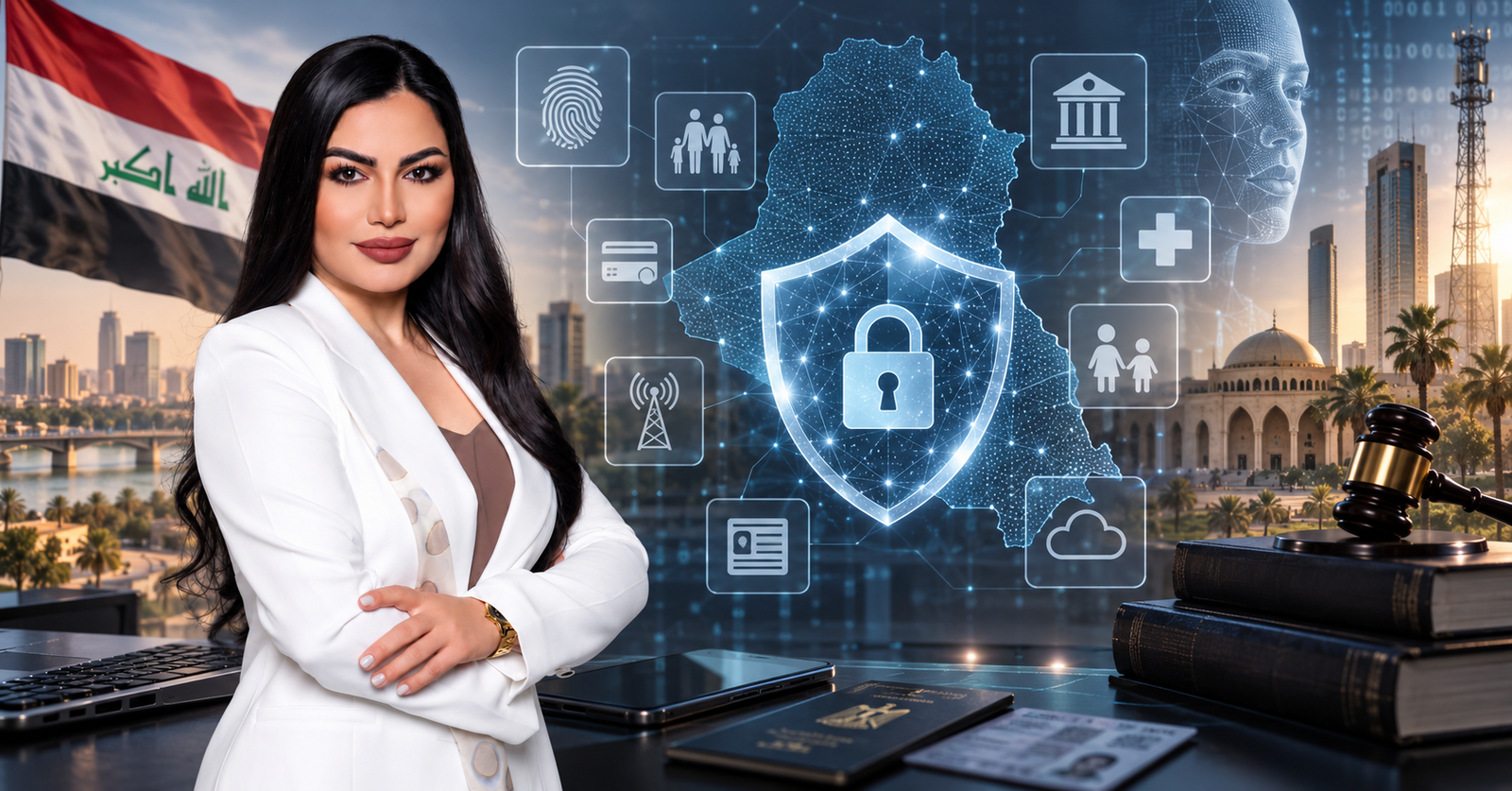

In the digital age, national sovereignty is no longer defined solely by geographical borders, natural resources, and traditional institutions. A new dimension has emerged—one that is no less important: digital sovereignty.
As government, banking, educational, healthcare, and commercial services increasingly move into the digital environment, enormous volumes of data are generated every day. Citizens’ data, government records, financial transactions, documents, institutional systems, and even data generated by artificial intelligence applications have all become strategic national assets.
This raises a fundamental question that should be part of any serious digital transformation initiative in Iraq:
Where is our data stored? Who processes it? Who can access it? And under which laws and jurisdictions does it fall?
These are not merely technical questions. They are directly connected to national security, the economy, privacy, service continuity, and the state’s ability to make independent decisions about its digital future.
What Does Digital Sovereignty Mean?
Digital sovereignty does not mean isolating Iraq from the global internet, nor does it mean rejecting foreign technologies and services.
The concept is much broader.
Digital sovereignty refers to the ability of a state, its institutions, and its society to manage their data, digital infrastructure, and critical technologies in accordance with national interests, laws, and decisions, while retaining the ability to benefit from global technological innovation.
Digital sovereignty encompasses several interconnected dimensions:
Data sovereignty: Knowing where data resides, how it is stored and processed, and who is authorized to access it.
Infrastructure sovereignty: Owning or maintaining effective control over critical components of data centers, networks, platforms, and cloud infrastructure.
Technological sovereignty: Reducing excessive dependence on a single vendor, platform, or technology in ways that could make migration impossible or prohibitively expensive.
Legal sovereignty: Establishing clear laws that define the rights of individuals and institutions, as well as the responsibilities of entities that collect and process data.
Cyber sovereignty: Maintaining the ability to protect the national digital environment and respond effectively to cyberattacks and security incidents.
Iraq’s National Cybersecurity Center, one of the entities operating under the Office of the Prime Minister, includes digital sovereignty and strengthening trust in government services and the digital economy within its vision for building a secure and protected Iraqi cyberspace.
Why Has Data Become a Matter of Sovereignty?
In the past, an institution’s most valuable assets were often its buildings, physical archives, and equipment.
Today, its database may be more valuable than many of its physical assets.
Consider the volume of data generated by an entire country through:
Civil records, health data, educational information, taxation, electronic payments, banking information, maps, public projects, energy, telecommunications, border crossings, transportation systems, and government services.
When these systems become digital, protecting them is no longer simply about preventing the theft of a single file. It is about protecting the state’s ability to deliver essential services and continue operating.
For this reason, data has become an integral component of modern national infrastructure.
Where Does Iraq Stand Today?
There are encouraging indicators, but significant work remains to be done.
According to Internet Society data updated for 2026, internet usage in Iraq stands at approximately 81% of the population, while the country’s Internet Resilience Index is approximately 49 out of 100. The organization also tracks three active data centers and one active Internet Exchange Point (IXP) in Iraq, while IPv6 adoption stands at approximately 2%, compared with an Asian average of 41%.
These figures do not mean that Iraq lacks digital infrastructure. Rather, they indicate that there is substantial room to strengthen the capacity, resilience, and development of the country’s local digital infrastructure.
Internet Society data also indicates that approximately 60% of the 1,000 most-used websites in Iraq can have their content accessed through a server or cache located within the country, while 40% of active networks can exchange traffic through members of the local Internet Exchange Point.
These may appear to be technical details, but they also carry significant economic and sovereignty implications.
The stronger the local infrastructure becomes, the greater the potential to improve efficiency, reduce certain forms of dependence on international routes, and enhance the resilience of digital services.
Data Centers Are More Than Buildings Full of Servers
One common misconception is to think of a data center simply as a collection of servers housed in a temperature-controlled building.
A modern data center is not merely technical infrastructure; it is part of a country’s broader economic and strategic infrastructure.
It requires stable power, high-capacity connectivity, cooling systems, physical protection, cybersecurity, backup systems, business continuity and disaster recovery capabilities, as well as highly specialized technical teams.
In April 2026, Iraq’s Communications and Media Commission announced the approval of regulations governing data center services in Iraq, as part of broader efforts to support the country’s digital infrastructure and regulate the sector.
This is an important development because building a national data center industry does not serve government institutions alone. It can evolve into a comprehensive investment sector serving banks, businesses, universities, digital platforms, artificial intelligence systems, and cloud services.
Is Storing All Data Inside Iraq the Solution?
Not necessarily.
This distinction is fundamental to understanding digital sovereignty.
Digital sovereignty does not simply mean that every server must be physically located within Iraq’s borders.
A system may be hosted locally while remaining entirely dependent on technologies over which the institution has little control, or it may suffer from weak security management.
Conversely, an institution may use a global cloud service under strong contractual safeguards, encryption standards, and access-control policies that provide a high level of security and continuity.
Therefore, the right question is not simply:
Inside Iraq or outside Iraq?
Rather, we should ask:
What type of data is involved? How sensitive is it? Where may it legally and securely be stored? Who controls the encryption keys? Which jurisdiction governs the service provider? And how can the data be recovered or transferred when the relationship with that provider ends?
From this perspective, Iraq could adopt a carefully designed hybrid cloud model, combining national infrastructure with cloud services where appropriate, rather than treating local and global infrastructure as mutually exclusive choices.
Data Classification Must Come Before Data Sovereignty
Meaningful data sovereignty cannot be achieved if all data is treated in exactly the same way.
Iraq needs a clear data-classification framework, for example:
Public data: Information that can be openly published and used.
Internal data: Institutional information that is not intended for public disclosure.
Sensitive data: Information requiring stronger security controls.
Highly sensitive or sovereign data: Information requiring the highest levels of protection, control, and monitoring.
Once data is properly classified, appropriate rules can be established for storage, processing, sharing, retention, deletion, and backup according to each level.
Digital sovereignty begins with knowing what data we actually possess.
Personal Data and Legislation
There can be no meaningful discussion of digital sovereignty without addressing citizens’ privacy.
Digital transformation makes collecting data significantly easier. But the fact that data can be collected does not mean that every piece of information should be collected—or retained indefinitely.
Iraqi legal studies published in 2026 continue to highlight the need for a specialized and comprehensive legal framework for personal data protection that can keep pace with the expansion of digital services and artificial intelligence.
This leads to several principles that should become integral to the design of digital services:
Collect only the data that is necessary; clearly define the purpose for which it will be used; establish appropriate retention periods; control access privileges; encrypt sensitive information; log significant access activities; and implement clear mechanisms for responding to data breaches or misuse.
In other words:
Privacy by Design and Security by Design should not be added after a system has been built. They should be embedded into its architecture from the very beginning.
Artificial Intelligence Makes Digital Sovereignty Even More Important
A new development has made this issue even more urgent: artificial intelligence.
Modern AI systems do not rely solely on software. They depend on data, computing capacity, models, servers, and cloud infrastructure.
In April 2026, Iraq’s Ministry of Planning discussed the country’s artificial intelligence strategy. Among the initiatives raised was the development of a sovereign national language model (Iraq LLM), alongside AI infrastructure incorporating both local physical servers and cloud-based servers.
This is a development worth examining closely.
Building national AI capabilities does not simply mean creating an Iraqi chatbot.
It could extend to Arabic-language and local-dialect processing, government data analysis, service development, decision support, and the creation of digital knowledge more closely aligned with Iraq’s national context.
But this raises another critical question:
What data will be used to train these systems? And who will own the data, the models, and their outputs?
This is precisely where data sovereignty and AI sovereignty intersect.
Cybersecurity Is the Defensive Layer of Digital Sovereignty
Digital sovereignty has little value without cybersecurity.
A country may operate local data centers and national systems, but if those systems are poorly protected, the geographical location of the servers alone will not solve the problem.
Digital sovereignty requires:
Identity and access management, encryption, security monitoring, vulnerability management, backups, incident-response plans, disaster recovery, software supply-chain security, regular testing, and effective Security Operations Centers.
Iraq’s National Cybersecurity Center identifies the protection of critical infrastructure and sensitive data, as well as capacity building and cyber readiness, among its stated missions and objectives.
At the legislative level, Iraq is also continuing to develop a legal framework for addressing crimes associated with the digital environment. In July 2026, the Iraqi Council of Representatives conducted the first reading of the Proposed Law on Combating Information Technology Crimes. Discussions subsequently continued within parliamentary committees, including deliberations on September 1, 2026, concerning the legal and technical aspects of crimes committed through information and communications technologies.
This legislative process is taking place within a broader legal and public debate over the need for legislation that strikes an appropriate balance between combating cybercrime and protecting society and data on the one hand, and safeguarding digital rights and freedom of expression on the other.
This demonstrates that digital infrastructure cannot evolve independently of security, legislation, and governance.
The Risk of Dependence on a Single Vendor
An important concept in digital sovereignty is vendor lock-in.
Vendor lock-in occurs when an institution adopts a system or platform in a way that makes transferring its data or migrating to another provider extremely difficult or prohibitively expensive.
For this reason, government and institutional contracts should address these considerations from the outset:
Data export capabilities, system portability, the use of open standards where appropriate, clear data ownership provisions, and a defined exit strategy.
A strong digital state does not need to develop every technology on its own. However, it must not lose its ability to choose and maintain control.
Digital Sovereignty Is Not Only About Security—It Is Also About the Economy
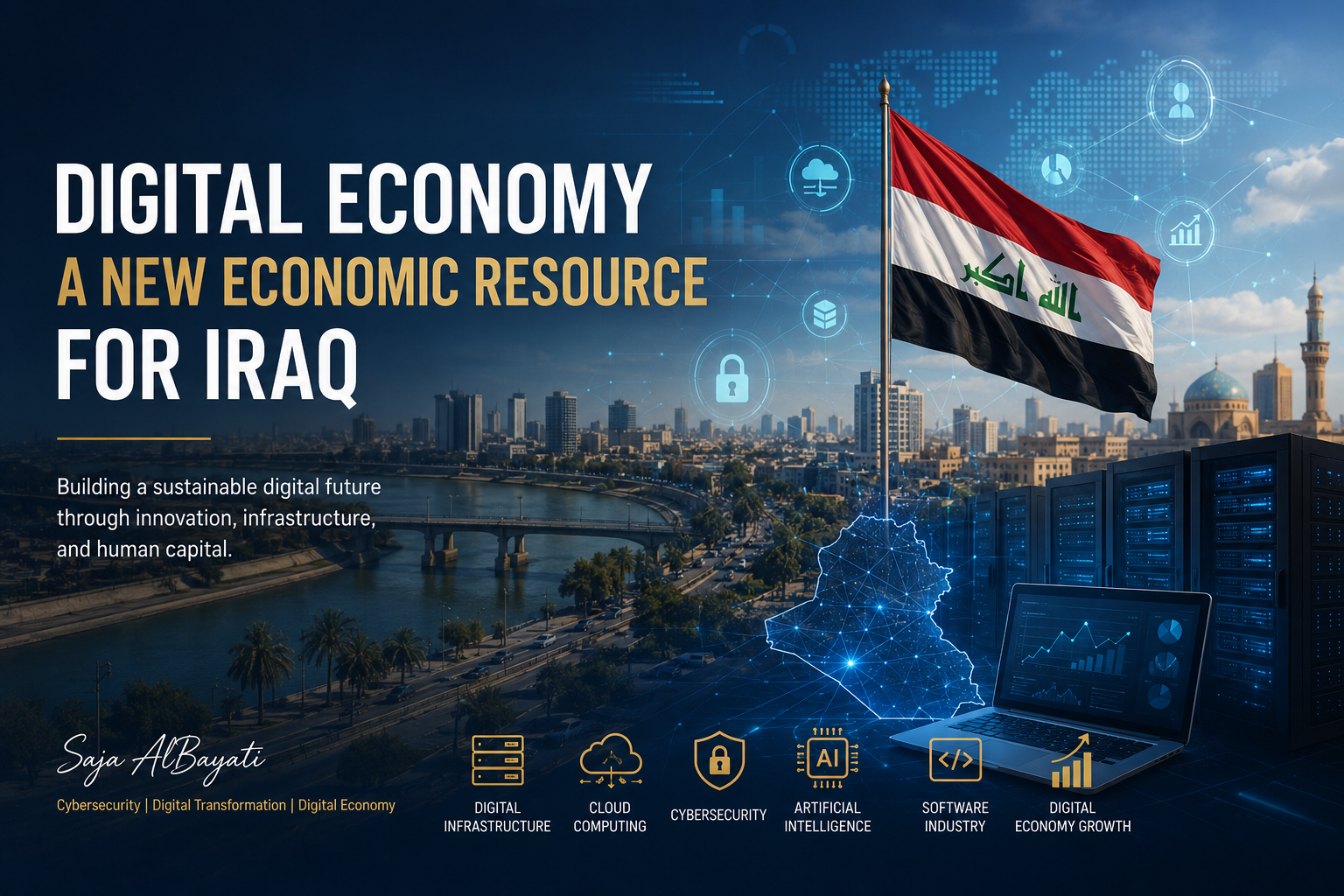
This point directly connects to what I discussed in my previous article, “Digital Economy: A New Economic Resource for Iraq.”
If Iraq develops its data centers, cloud services, cybersecurity capabilities, software industry, and artificial intelligence ecosystem, part of the expenditure currently directed toward purchasing technology services could instead become investment within the Iraqi economy.
This would generate demand for:
Cloud engineers, cybersecurity specialists, network engineers, software developers, data engineers, AI specialists, data center managers, privacy and compliance professionals, and digital systems auditors.
Digital sovereignty can therefore bring together two strategic objectives:
Protecting national interests + building a domestic digital industry.
What Does Iraq Need in Practice?
In my view, building meaningful digital sovereignty requires an integrated national approach—not a single project or a single data center.
It begins with establishing a national data governance strategy that defines ownership, classification, storage, processing, and sharing.
This should be followed by the development of a comprehensive framework for personal data protection.
At the same time, Iraq should expand its national data center and cloud infrastructure in accordance with clear standards for security and reliability.
The country also needs to strengthen its core internet infrastructure, expand local traffic exchange points, and accelerate the adoption of modern technologies such as IPv6, particularly given that its adoption rate in Iraq remains low according to Internet Society data for 2026.
These measures should be accompanied by clear policies for government cloud services, secure digital identity management, encryption of sensitive data, and robust incident-response and disaster-recovery plans.
In artificial intelligence, establishing governance frameworks for both data and models should precede large-scale adoption.
Most importantly, however, is the human element.
There can be no genuine digital sovereignty without Iraqi professionals capable of designing, operating, securing, auditing, and continuously developing these systems.
Digital Sovereignty Does Not Mean Isolation
The concept of digital sovereignty must not become a call for technological isolation.
Iraq needs global companies, international cooperation, investment, cloud computing, knowledge transfer, and international standards.
But there is a significant difference between cooperation and complete dependence.
The goal is not for Iraq to manufacture every semiconductor or develop every piece of software domestically.
The goal is to understand:
Which technologies can be procured from external providers?
Which data may be hosted abroad?
Which assets should remain under greater national control?
And which capabilities should the state never become entirely dependent on external parties to provide?
That is what practical digital sovereignty means.
From a Consumer of Data to a State That Manages Its Digital Assets
Iraq has an important opportunity.
The country is not starting from zero. There is already tangible movement in cybersecurity, data centers, artificial intelligence, and the regulation of the digital environment. The next stage, however, should move beyond isolated digital projects toward an integrated national vision.
Successful digital transformation should not be measured by the number of applications launched or by how many transactions are moved from paper to a screen.
Real success lies in building a secure, resilient, and sustainable digital environment that protects citizens’ data and gives the state the ability to manage its digital resources and make technological decisions with confidence.
The data we generate today will become part of the decisions, economic systems, and artificial intelligence technologies on which we will depend tomorrow.
Therefore, if the digital economy represents a new economic resource for Iraq, digital sovereignty is one of the fundamental conditions for protecting that resource and maximizing its value.
Sovereignty in the digital age does not mean closing our doors to the world. It means engaging with the world while retaining the ability to protect our data, choose our technologies, and manage our digital future.
Eng. Saja Albayati
Digital Transformation & Cybersecurity Consultant
<!-- SAJA_BACKLINK_DATA_PROTECTION_FINAL --><p>Digital sovereignty is directly connected to data governance and Iraqis’ data protection.</p>
As government, banking, educational, healthcare, and commercial services increasingly move into the digital environment, enormous volumes of data are generated every day. Citizens’ data, government records, financial transactions, documents, institutional systems, and even data generated by artificial intelligence applications have all become strategic national assets.
This raises a fundamental question that should be part of any serious digital transformation initiative in Iraq:
Where is our data stored? Who processes it? Who can access it? And under which laws and jurisdictions does it fall?
These are not merely technical questions. They are directly connected to national security, the economy, privacy, service continuity, and the state’s ability to make independent decisions about its digital future.
What Does Digital Sovereignty Mean?
Digital sovereignty does not mean isolating Iraq from the global internet, nor does it mean rejecting foreign technologies and services.
The concept is much broader.
Digital sovereignty refers to the ability of a state, its institutions, and its society to manage their data, digital infrastructure, and critical technologies in accordance with national interests, laws, and decisions, while retaining the ability to benefit from global technological innovation.
Digital sovereignty encompasses several interconnected dimensions:
Data sovereignty: Knowing where data resides, how it is stored and processed, and who is authorized to access it.
Infrastructure sovereignty: Owning or maintaining effective control over critical components of data centers, networks, platforms, and cloud infrastructure.
Technological sovereignty: Reducing excessive dependence on a single vendor, platform, or technology in ways that could make migration impossible or prohibitively expensive.
Legal sovereignty: Establishing clear laws that define the rights of individuals and institutions, as well as the responsibilities of entities that collect and process data.
Cyber sovereignty: Maintaining the ability to protect the national digital environment and respond effectively to cyberattacks and security incidents.
Iraq’s National Cybersecurity Center, one of the entities operating under the Office of the Prime Minister, includes digital sovereignty and strengthening trust in government services and the digital economy within its vision for building a secure and protected Iraqi cyberspace.
Why Has Data Become a Matter of Sovereignty?
In the past, an institution’s most valuable assets were often its buildings, physical archives, and equipment.
Today, its database may be more valuable than many of its physical assets.
Consider the volume of data generated by an entire country through:
Civil records, health data, educational information, taxation, electronic payments, banking information, maps, public projects, energy, telecommunications, border crossings, transportation systems, and government services.
When these systems become digital, protecting them is no longer simply about preventing the theft of a single file. It is about protecting the state’s ability to deliver essential services and continue operating.
For this reason, data has become an integral component of modern national infrastructure.
Where Does Iraq Stand Today?
There are encouraging indicators, but significant work remains to be done.
According to Internet Society data updated for 2026, internet usage in Iraq stands at approximately 81% of the population, while the country’s Internet Resilience Index is approximately 49 out of 100. The organization also tracks three active data centers and one active Internet Exchange Point (IXP) in Iraq, while IPv6 adoption stands at approximately 2%, compared with an Asian average of 41%.
These figures do not mean that Iraq lacks digital infrastructure. Rather, they indicate that there is substantial room to strengthen the capacity, resilience, and development of the country’s local digital infrastructure.
Internet Society data also indicates that approximately 60% of the 1,000 most-used websites in Iraq can have their content accessed through a server or cache located within the country, while 40% of active networks can exchange traffic through members of the local Internet Exchange Point.
These may appear to be technical details, but they also carry significant economic and sovereignty implications.
The stronger the local infrastructure becomes, the greater the potential to improve efficiency, reduce certain forms of dependence on international routes, and enhance the resilience of digital services.
Data Centers Are More Than Buildings Full of Servers
One common misconception is to think of a data center simply as a collection of servers housed in a temperature-controlled building.
A modern data center is not merely technical infrastructure; it is part of a country’s broader economic and strategic infrastructure.
It requires stable power, high-capacity connectivity, cooling systems, physical protection, cybersecurity, backup systems, business continuity and disaster recovery capabilities, as well as highly specialized technical teams.
In April 2026, Iraq’s Communications and Media Commission announced the approval of regulations governing data center services in Iraq, as part of broader efforts to support the country’s digital infrastructure and regulate the sector.
This is an important development because building a national data center industry does not serve government institutions alone. It can evolve into a comprehensive investment sector serving banks, businesses, universities, digital platforms, artificial intelligence systems, and cloud services.
Is Storing All Data Inside Iraq the Solution?
Not necessarily.
This distinction is fundamental to understanding digital sovereignty.
Digital sovereignty does not simply mean that every server must be physically located within Iraq’s borders.
A system may be hosted locally while remaining entirely dependent on technologies over which the institution has little control, or it may suffer from weak security management.
Conversely, an institution may use a global cloud service under strong contractual safeguards, encryption standards, and access-control policies that provide a high level of security and continuity.
Therefore, the right question is not simply:
Inside Iraq or outside Iraq?
Rather, we should ask:
What type of data is involved? How sensitive is it? Where may it legally and securely be stored? Who controls the encryption keys? Which jurisdiction governs the service provider? And how can the data be recovered or transferred when the relationship with that provider ends?
From this perspective, Iraq could adopt a carefully designed hybrid cloud model, combining national infrastructure with cloud services where appropriate, rather than treating local and global infrastructure as mutually exclusive choices.
Data Classification Must Come Before Data Sovereignty
Meaningful data sovereignty cannot be achieved if all data is treated in exactly the same way.
Iraq needs a clear data-classification framework, for example:
Public data: Information that can be openly published and used.
Internal data: Institutional information that is not intended for public disclosure.
Sensitive data: Information requiring stronger security controls.
Highly sensitive or sovereign data: Information requiring the highest levels of protection, control, and monitoring.
Once data is properly classified, appropriate rules can be established for storage, processing, sharing, retention, deletion, and backup according to each level.
Digital sovereignty begins with knowing what data we actually possess.
Personal Data and Legislation
There can be no meaningful discussion of digital sovereignty without addressing citizens’ privacy.
Digital transformation makes collecting data significantly easier. But the fact that data can be collected does not mean that every piece of information should be collected—or retained indefinitely.
Iraqi legal studies published in 2026 continue to highlight the need for a specialized and comprehensive legal framework for personal data protection that can keep pace with the expansion of digital services and artificial intelligence.
This leads to several principles that should become integral to the design of digital services:
Collect only the data that is necessary; clearly define the purpose for which it will be used; establish appropriate retention periods; control access privileges; encrypt sensitive information; log significant access activities; and implement clear mechanisms for responding to data breaches or misuse.
In other words:
Privacy by Design and Security by Design should not be added after a system has been built. They should be embedded into its architecture from the very beginning.
Artificial Intelligence Makes Digital Sovereignty Even More Important
A new development has made this issue even more urgent: artificial intelligence.
Modern AI systems do not rely solely on software. They depend on data, computing capacity, models, servers, and cloud infrastructure.
In April 2026, Iraq’s Ministry of Planning discussed the country’s artificial intelligence strategy. Among the initiatives raised was the development of a sovereign national language model (Iraq LLM), alongside AI infrastructure incorporating both local physical servers and cloud-based servers.
This is a development worth examining closely.
Building national AI capabilities does not simply mean creating an Iraqi chatbot.
It could extend to Arabic-language and local-dialect processing, government data analysis, service development, decision support, and the creation of digital knowledge more closely aligned with Iraq’s national context.
But this raises another critical question:
What data will be used to train these systems? And who will own the data, the models, and their outputs?
This is precisely where data sovereignty and AI sovereignty intersect.
Cybersecurity Is the Defensive Layer of Digital Sovereignty
Digital sovereignty has little value without cybersecurity.
A country may operate local data centers and national systems, but if those systems are poorly protected, the geographical location of the servers alone will not solve the problem.
Digital sovereignty requires:
Identity and access management, encryption, security monitoring, vulnerability management, backups, incident-response plans, disaster recovery, software supply-chain security, regular testing, and effective Security Operations Centers.
Iraq’s National Cybersecurity Center identifies the protection of critical infrastructure and sensitive data, as well as capacity building and cyber readiness, among its stated missions and objectives.
At the legislative level, Iraq is also continuing to develop a legal framework for addressing crimes associated with the digital environment. In July 2026, the Iraqi Council of Representatives conducted the first reading of the Proposed Law on Combating Information Technology Crimes. Discussions subsequently continued within parliamentary committees, including deliberations on September 1, 2026, concerning the legal and technical aspects of crimes committed through information and communications technologies.
This legislative process is taking place within a broader legal and public debate over the need for legislation that strikes an appropriate balance between combating cybercrime and protecting society and data on the one hand, and safeguarding digital rights and freedom of expression on the other.
This demonstrates that digital infrastructure cannot evolve independently of security, legislation, and governance.
The Risk of Dependence on a Single Vendor
An important concept in digital sovereignty is vendor lock-in.
Vendor lock-in occurs when an institution adopts a system or platform in a way that makes transferring its data or migrating to another provider extremely difficult or prohibitively expensive.
For this reason, government and institutional contracts should address these considerations from the outset:
Data export capabilities, system portability, the use of open standards where appropriate, clear data ownership provisions, and a defined exit strategy.
A strong digital state does not need to develop every technology on its own. However, it must not lose its ability to choose and maintain control.
Digital Sovereignty Is Not Only About Security—It Is Also About the Economy
This point directly connects to what I discussed in my previous article, “Digital Economy: A New Economic Resource for Iraq.”
If Iraq develops its data centers, cloud services, cybersecurity capabilities, software industry, and artificial intelligence ecosystem, part of the expenditure currently directed toward purchasing technology services could instead become investment within the Iraqi economy.
This would generate demand for:
Cloud engineers, cybersecurity specialists, network engineers, software developers, data engineers, AI specialists, data center managers, privacy and compliance professionals, and digital systems auditors.
Digital sovereignty can therefore bring together two strategic objectives:
Protecting national interests + building a domestic digital industry.
What Does Iraq Need in Practice?
In my view, building meaningful digital sovereignty requires an integrated national approach—not a single project or a single data center.
It begins with establishing a national data governance strategy that defines ownership, classification, storage, processing, and sharing.
This should be followed by the development of a comprehensive framework for personal data protection.
At the same time, Iraq should expand its national data center and cloud infrastructure in accordance with clear standards for security and reliability.
The country also needs to strengthen its core internet infrastructure, expand local traffic exchange points, and accelerate the adoption of modern technologies such as IPv6, particularly given that its adoption rate in Iraq remains low according to Internet Society data for 2026.
These measures should be accompanied by clear policies for government cloud services, secure digital identity management, encryption of sensitive data, and robust incident-response and disaster-recovery plans.
In artificial intelligence, establishing governance frameworks for both data and models should precede large-scale adoption.
Most importantly, however, is the human element.
There can be no genuine digital sovereignty without Iraqi professionals capable of designing, operating, securing, auditing, and continuously developing these systems.
Digital Sovereignty Does Not Mean Isolation
The concept of digital sovereignty must not become a call for technological isolation.
Iraq needs global companies, international cooperation, investment, cloud computing, knowledge transfer, and international standards.
But there is a significant difference between cooperation and complete dependence.
The goal is not for Iraq to manufacture every semiconductor or develop every piece of software domestically.
The goal is to understand:
Which technologies can be procured from external providers?
Which data may be hosted abroad?
Which assets should remain under greater national control?
And which capabilities should the state never become entirely dependent on external parties to provide?
That is what practical digital sovereignty means.
From a Consumer of Data to a State That Manages Its Digital Assets
Iraq has an important opportunity.
The country is not starting from zero. There is already tangible movement in cybersecurity, data centers, artificial intelligence, and the regulation of the digital environment. The next stage, however, should move beyond isolated digital projects toward an integrated national vision.
Successful digital transformation should not be measured by the number of applications launched or by how many transactions are moved from paper to a screen.
Real success lies in building a secure, resilient, and sustainable digital environment that protects citizens’ data and gives the state the ability to manage its digital resources and make technological decisions with confidence.
The data we generate today will become part of the decisions, economic systems, and artificial intelligence technologies on which we will depend tomorrow.
Therefore, if the digital economy represents a new economic resource for Iraq, digital sovereignty is one of the fundamental conditions for protecting that resource and maximizing its value.
Sovereignty in the digital age does not mean closing our doors to the world. It means engaging with the world while retaining the ability to protect our data, choose our technologies, and manage our digital future.
Eng. Saja Albayati
Digital Transformation & Cybersecurity Consultant
<!-- SAJA_BACKLINK_DATA_PROTECTION_FINAL --><p>Digital sovereignty is directly connected to data governance and Iraqis’ data protection.</p>