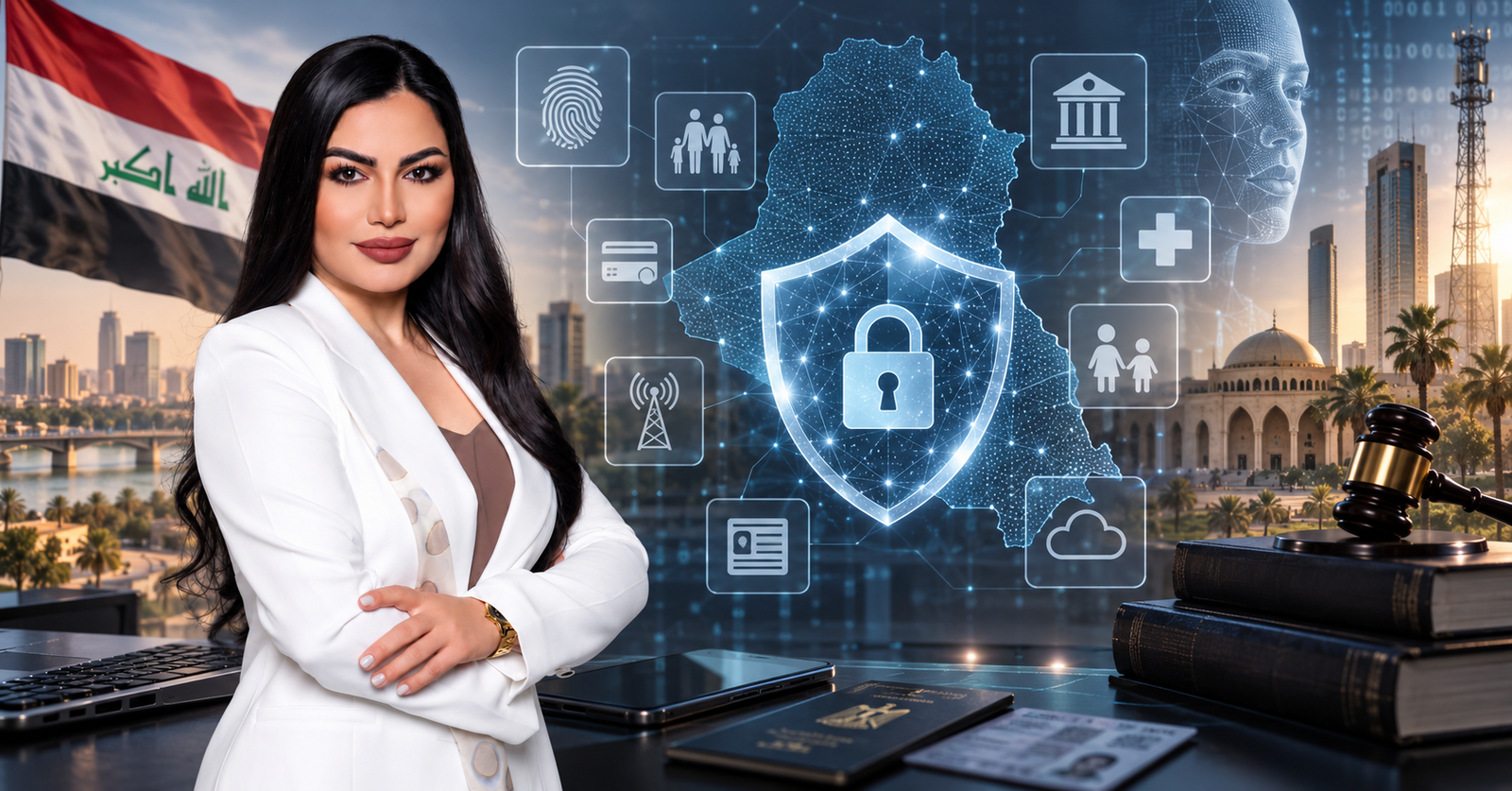

The Question Is No Longer: When Will Artificial Intelligence Reach Iraq?
Artificial intelligence is already here.
It has entered citizens’ smartphones, government offices, universities, newsrooms, businesses, software development, design, marketing, research, data analysis, and customer service.
Students use it for learning. Developers use it to write and analyze code. Businesses use it for marketing and operations. Journalists use it for research, transcription, and translation. Citizens use it in their everyday lives. Meanwhile, government institutions have begun exploring how AI can gradually support public services, analysis, and decision-making.
The question has therefore changed.
It is no longer:
Will Iraq use artificial intelligence?
It is now:
How will Iraq use it? Who will establish the rules? Who will protect the data? Who will be accountable when an AI system makes a mistake? What decisions should machines be allowed to make, and what decisions must remain in human hands?
Artificial intelligence could help Iraq accelerate development in certain sectors, increase institutional productivity, improve public services, strengthen the economy, and support decision-making.
But it could also amplify existing problems if deployed within institutions that lack effective governance, built on incomplete or inaccurate data, or used in sensitive decisions without adequate oversight and accountability.
The issue, therefore, is not a race to acquire the largest number of AI tools.
The real objective is to build a national capacity to use artificial intelligence safely, responsibly, and in ways that create genuine value for Iraq.
Where Does Iraq Stand in 2026?
Iraq is no longer at the stage of discussing artificial intelligence only in theoretical terms.
In recent years, the issue has gradually moved to the institutional and governmental level, with initiatives related to capacity building, the development of a national strategy, and the integration of AI into Iraq’s broader digital transformation.
In April 2026, Iraq’s Ministry of Planning discussed the country’s artificial intelligence strategy. The discussions included the development of measurable objectives, a mechanism for creating a sovereign national Large Language Model (Iraq LLM), and the infrastructure required to support it, including local servers and cloud services.
The Higher Committee for Artificial Intelligence had also previously discussed a roadmap for developing national capabilities and adopting Fourth Industrial Revolution technologies, with particular attention to sectors including education, energy, and skills development.
During 2026, government attention also expanded toward digital governance, cybersecurity, and adapting artificial intelligence for public-service delivery, alongside broader efforts involving digital transformation, legislation, policy development, digital infrastructure, and workforce capacity building.
These are positive developments that should be built upon.
However, it is important to distinguish between beginning the journey and establishing a mature national ecosystem.
The existence of a strategy, committee, or national project does not mean that Iraq’s artificial intelligence ecosystem is complete.
A mature ecosystem requires legislation, governance, standards, high-quality data, infrastructure, cybersecurity, skilled professionals, financing, research capabilities, and clear mechanisms for auditing, accountability, and measuring outcomes.
This is the stage on which Iraq now needs to focus.
Artificial Intelligence Is Not Merely a Technology Project
One of the greatest mistakes any country can make is to treat artificial intelligence as a project belonging exclusively to its IT departments.
AI is not simply software.
It affects public administration, law, the economy, education, healthcare, employment, security, privacy, citizens’ rights, infrastructure, energy, language, government procurement, and digital sovereignty.
A national AI strategy should therefore not begin by asking:
Which model should we buy?
It should begin with more important questions:
What national problems are we trying to solve?
Do we genuinely need AI to solve them?
What data do we have?
Is our data ready?
What is the level of risk?
Who is responsible for the system?
How will success be measured?
And which areas require greater oversight?
Artificial intelligence is a means, not an objective in itself.
In some cases, the best solution may be a simple conventional system rather than a complex and expensive AI model.
This distinction is important if Iraq is to avoid turning AI initiatives into technology spending without measurable value.
What Can Artificial Intelligence Offer the Iraqi Government?
Iraqi government institutions have numerous potential use cases capable of generating real value.
AI can be used to analyze and categorize citizens’ complaints, search through large volumes of government documents, analyze statistical data, support planning, improve contact centers, predict certain types of failures, identify unusual patterns, optimize resource allocation, assist in fraud detection, and develop more proactive public services.
An intelligent government assistant could also help citizens identify the correct service, understand its requirements, and locate the responsible authority without navigating dozens of pages and instructions.
However, adding a chatbot to a ministry’s website does not make that ministry intelligent.
The real measures of success should be:
Has transaction processing time decreased?
Have errors been reduced?
Have costs declined?
Has the citizen experience improved?
Are decisions more accurate?
Has access to public services become easier?
And has this been achieved while protecting privacy, security, and citizens’ rights?
If the impact cannot be measured, the project may represent a demonstration of technology rather than genuine transformation.
Citizens Must Remain at the Center of the Ecosystem
Ultimately, citizens will experience the consequences of many of these systems.
A citizen may interact with an intelligent government assistant.
They may use an AI-supported healthcare service.
Their application may pass through an automated screening system.
They may receive an educational or financial recommendation generated with AI assistance.
Citizens should therefore know when they are interacting with an automated system and when a decision is being made by a human.
They should also know where to turn when the system makes a mistake.
If a government AI system rejects a citizen’s application, the answer should not simply be:
“The system rejected it.”
A machine cannot become a mechanism for distributing responsibility until no one is accountable.
A clearly identifiable human and institutional authority must remain responsible for the decision, particularly when it concerns a right, public service, resource, or opportunity that can materially affect a person’s life.
Data Is the Fuel — but Its Quality Determines the Quality of the Outcome
There is no reliable artificial intelligence built on unreliable data.
If databases are incomplete, duplicated, outdated, or inconsistent across government institutions, AI will not automatically correct those weaknesses.
It may simply transform an existing error into a faster and more widely applied decision.
Government AI projects should therefore be preceded by genuine Data Governance.
An institution should know:
What data does it hold?
What is its quality?
Who is responsible for it?
Where did it come from?
How was it collected?
Who can access it?
Can it legally and appropriately be used for the new purpose?
How long should it be retained?
And does it fairly represent the people to whom the AI system will be applied?
Before an institution asks:
Which model should we use?
It should first ask:
Is our data actually fit for use in this model?
Artificial Intelligence and the Privacy of Iraqis
Artificial intelligence increases the value of data, but it also increases the risks associated with it.
AI systems can analyze enormous volumes of information, identify relationships, and infer information that citizens never explicitly disclosed.
An institution may originally have collected information for a specific administrative purpose and later decide to use that information to train a model, classify citizens, or predict particular behaviors.
This raises a fundamental question:
Does possessing data automatically give an institution the right to use it for any new purpose?
The answer should not automatically be yes.
The development of government AI should therefore proceed alongside the development of a stronger framework for personal data protection and privacy in Iraq.
The more sensitive the information—including health, financial, biometric, and children’s data—the stronger the protection requirements should be.
Privacy Impact Assessments should also become part of high-risk projects so that the consequences of data use are evaluated before a system is deployed, rather than after harm occurs.
Artificial Intelligence in Iraqi Healthcare
Healthcare is one of the sectors that could benefit most from AI, while simultaneously being one of the most sensitive.
AI can support medical-image analysis, assist diagnosis, organize appointments, improve resource management, identify certain disease patterns, and help physicians access relevant information more efficiently.
However, an error in healthcare may represent more than inaccurate information.
It can affect a human life.
Medical AI should therefore remain a tool that supports physicians, not an autonomous substitute that operates without accountability.
Any system capable of influencing diagnosis or treatment should be subject to scientific evaluation, clinical-safety requirements, high-quality data standards, human oversight, and continuous monitoring.
Health records are also among the most sensitive categories of personal information. Their use in external AI systems should therefore be subject to stringent privacy and security safeguards.
Artificial Intelligence and Education
Artificial intelligence can create significant opportunities for Iraqi education.
It can serve as a learning assistant, explain lessons in different ways, help teachers prepare materials, support translation and simplification, generate additional exercises, and help students learn at their own pace.
But there is another side to the issue.
If students begin using AI to write every assignment and solve every problem, Iraq may achieve better grades without achieving better learning.
The question should therefore change from:
Should students be allowed to use AI?
to:
How should education and assessment be redesigned for the age of artificial intelligence?
The new skill is not simply knowing the answer.
It is knowing how to ask the right question, verify the answer, identify errors, compare sources, and preserve independent thinking even when an AI tool is available.
Children and Artificial Intelligence
Children require a higher level of protection.
A child may enter their name, school, location, a family issue, or health information into a chatbot. They may upload a personal photograph without understanding where that information goes or how it may be used.
Children may also encounter misleading or inappropriate content or systems designed to encourage prolonged engagement.
For this reason, AI Literacy should become part of digital-literacy programs in Iraq.
Children and students should be taught:
What information can be shared with AI tools?
What should never be shared?
How can AI-generated answers be verified?
Why can an AI system be wrong?
And when should they turn to a parent, teacher, or qualified professional?
Any future Iraqi legislation or national AI governance framework should also treat children as a group requiring specific protections—not simply as smaller versions of adult users.
Banking and the Financial Sector
Artificial intelligence can help banks and payment companies detect fraud, analyze risk, improve customer service, identify unusual transactions, and streamline certain internal processes.
However, when AI is used to evaluate customers, creditworthiness, or risk, the implications become more sensitive.
If an automated system rejects a customer, can that person understand why?
Has the system been tested for bias?
Is the information used accurate and up to date?
Can a qualified employee review the decision?
And who is accountable if the decision is wrong?
Sensitive financial and banking information should also never be entered into public AI tools without strict institutional safeguards.
Energy, Oil, and Critical Infrastructure
Artificial intelligence can help Iraq forecast electricity demand, analyze failures, improve maintenance, monitor equipment, optimize resources, and analyze oil and energy data.
These applications could create significant economic value.
However, the closer AI becomes to critical infrastructure, the greater the potential consequences of failure or compromise.
An error or cyberattack affecting an administrative system may cause limited disruption.
An error affecting an energy system or critical facility can have far broader consequences.
AI systems deployed in critical sectors therefore require higher levels of testing, cybersecurity, operational continuity, recovery planning, and oversight.
Municipal Services and Smart Cities
Not all artificial intelligence applications are high-risk. There are areas where Iraq can begin generating tangible results relatively quickly and with lower levels of risk.
AI can be used to analyze and categorize citizens’ complaints by location and type, predict certain service failures, optimize waste-collection routes, analyze traffic patterns, detect water leaks, support maintenance operations, analyze infrastructure imagery, and help municipalities prioritize interventions.
These applications are particularly valuable because they allow institutions to measure results clearly.
Has response time decreased?
Have costs been reduced?
Has service quality improved?
Has resource allocation become more efficient?
This leads to an important principle that Iraq can adopt:
Start with the problem, not the technology.
Instead of asking, “Where can we use AI?” an institution should ask: “What problem are we trying to solve, and is artificial intelligence actually the best tool for solving it?”
Iraq’s Private Sector: A Major Economic Opportunity
Artificial intelligence is not only relevant to government.
Some of its fastest economic benefits may emerge within the private sector.
Banks can use AI for fraud detection, telecommunications companies for network and outage analysis, retailers for demand forecasting, manufacturers for predictive maintenance, logistics and delivery companies for route optimization, media organizations for content analysis, and software companies for improving development productivity.
Businesses can also use AI for customer service, sales analysis, marketing, operational management, and document search.
However, AI should not become merely a marketing label.
Not every product needs artificial intelligence.
In some cases, conventional software may be simpler, less expensive, more accurate, and more secure.
Companies should also not collect additional customer data simply because they “might need it to train a model in the future.”
The correct principle is:
Collect what is necessary, use it for a clearly defined purpose, and protect it throughout its lifecycle.
Small and Medium-Sized Enterprises
Iraqi small and medium-sized enterprises can benefit from the current AI transformation more than ever before because they no longer necessarily need large teams or dedicated computing infrastructure to access advanced tools.
However, ease of access creates another risk.
An employee may upload an Excel file containing customer data to a public service for analysis.
A confidential contract may be pasted into a chatbot for summarization.
Financial or commercial information may be entered into a tool without the company knowing where that information is stored.
Programs designed to support Iraqi businesses should therefore go beyond teaching business owners how to use AI.
They should also teach them:
What data should never be shared?
How should an AI provider be selected?
How should privacy terms be reviewed?
How should AI-generated results be verified?
And who is accountable when a business decision relies on incorrect information generated by an AI system?
The Labor Market: Will Artificial Intelligence Take Iraqis’ Jobs?
This question is being asked around the world, and the answer is more complex than simply “yes” or “no.”
In many cases, artificial intelligence will change tasks within jobs before eliminating entire occupations.
Accountants will use AI.
Developers will use it.
Engineers will use it.
Doctors, lawyers, journalists, and government employees will use it to varying degrees.
Some repetitive tasks will decline.
Some jobs will change.
New specializations will emerge.
The question Iraq should therefore ask is not only:
How many jobs might disappear?
But also:
Are we preparing Iraqis for the jobs and skills that will change or emerge?
The most realistic response is to invest in Reskilling and Upskilling.
Future competition may not always be between humans and artificial intelligence. It may increasingly be between a person who knows how to use AI effectively and responsibly and a person who does not.
What Skills Will Iraq Need?
Not every employee needs to become a data scientist or Machine Learning engineer.
However, Iraq needs widespread AI Literacy.
Users should understand:
How to use AI tools.
How to formulate clear requests.
How to verify results.
How to identify hallucinations and errors.
How to protect data.
What the system’s limitations are.
And when AI should not be used at all.
At the specialist level, Iraq needs to develop expertise in:
Data Science.
Machine Learning.
AI Engineering.
MLOps.
Data Engineering.
AI Security.
AI Governance.
Privacy.
Algorithmic Auditing.
And Model Evaluation.
Iraq also needs another group whose importance should not be underestimated: decision-makers and managers who understand AI well enough to make informed decisions about its adoption, risks, and governance.
Iraqi Universities Face a New Responsibility
If artificial intelligence education remains confined to theoretical concepts and algorithms inside classrooms, the gap between education and the labor market will continue to grow.
Iraq needs laboratories.
Applied projects.
Lawfully obtained and properly governed training datasets.
Partnerships between universities, government, and the private sector.
And research connected to real Iraqi challenges.
AI should also not remain a subject limited to computer science departments.
Medicine needs to understand it.
Law needs to understand its implications.
Management needs to understand its applications.
Media professionals need to understand synthetic content and deepfakes.
Engineering disciplines need to understand its practical uses.
At the same time, academic integrity and assessment methods must be reconsidered.
Universities should not produce students who simply know how to make AI write for them.
They should produce graduates who know how to use AI while retaining their own knowledge, analytical ability, critical thinking, and creativity.
Cybersecurity for Artificial Intelligence
Artificial intelligence is not merely a new cybersecurity tool.
It has also become a new attack surface.
AI can be used to analyze security alerts, identify abnormal activity, analyze malware and threats, and help security teams respond more quickly.
At the same time, attackers can use the same technologies to create more convincing phishing messages, impersonate individuals, generate synthetic content, and accelerate certain stages of an attack.
There are also threats that specifically target AI systems themselves.
Training data can be manipulated.
Attackers may attempt to extract sensitive information from a system.
APIs may be exploited.
Components and plugins connected to a model may be targeted.
Attackers may also attempt to influence model outputs through specially designed inputs.
For this reason, AI Security should become part of Iraq’s broader cybersecurity ecosystem.
When a government institution introduces an AI system into its infrastructure, security responsibilities should not end with protecting the server and network.
They must also cover:
The model.
The data.
APIs.
Accounts and access privileges.
Training sources.
External components.
Usage logs.
Updates.
And the vendor supply chain.
Shadow AI: When an Institution Uses AI Without Knowing It
One of the greatest AI risks inside an organization may emerge before the organization formally adopts any AI system.
This is known as Shadow AI.
It occurs when employees begin using public AI tools for work without the approval or knowledge of the organization’s IT and security departments.
A government employee may paste an official document into an AI tool for summarization.
An employee may upload a file containing personnel data for analysis.
A developer may paste part of a government system’s source code into an external coding assistant.
A bank employee may enter information about a customer or transaction to obtain assistance.
The problem is that the institution may not even know that its information has left its environment.
The solution is not necessarily to ban AI completely.
An unrealistic ban may simply encourage employees to use the tools outside institutional oversight.
A more mature approach is to establish an institutional AI-use policy defining:
Approved tools.
Permitted data.
Prohibited data.
Anonymization requirements.
Employee responsibilities.
Retention requirements.
And monitoring and training mechanisms.
Deepfakes: When Seeing and Hearing Are No Longer Enough
One of the most serious societal consequences of artificial intelligence is the rise of Deepfakes.
An image is no longer sufficient evidence on its own.
A voice is no longer sufficient evidence.
Even video may no longer be conclusive by itself.
The voice of a government official, company executive, or family member can be imitated.
Images and videos can increasingly be generated to appear authentic.
For citizens, such technologies may be used for fraud, extortion, and identity impersonation.
For businesses, a cloned executive voice could be used in an attempt to issue fraudulent financial instructions.
For the state, synthetic content can be used to spread disinformation and create confusion during significant events or crises.
Iraqi society therefore needs to move from a culture of:
“I saw it with my own eyes, so it must be real.”
to:
“I verified the source before believing or sharing it.”
Iraqi Media in the Age of AI
This transformation creates a new responsibility for Iraqi media organizations.
A story may reach a newsroom in the form of an AI-generated image, manipulated video, cloned voice, or a statement that the person concerned never actually made.
Verification of synthetic content will therefore become an essential component of journalism.
At the same time, media organizations can use AI for transcription, translation, research, archiving, data analysis, content classification, and editorial assistance.
But one principle should remain unchanged:
Artificial intelligence can assist the journalist, but it cannot assume editorial responsibility on the journalist’s behalf.
If an AI system generates false information and it is published, the party accountable to the public is not the algorithm. It is the media organization that chose to use and publish the content.
Should Artificial Intelligence Make Decisions About Citizens?
This is one of the most important questions Iraq needs to address before expanding government AI.
There is a major difference between a system that uses AI to categorize correspondence and one that determines who qualifies for a public service, benefit, or priority.
An intelligent system may help an employee identify a case that requires further review.
But what happens if the system begins deciding automatically:
Who qualifies?
Who is rejected?
Who is classified as high-risk?
Who receives priority?
At that point, we move from automating procedures to automating decisions that affect human lives.
The greater the impact on an individual’s rights, health, finances, education, or opportunities, the stronger the governance and human oversight must be.
Human-in-the-Loop: Humans Must Not Disappear from the Decision
One principle I believe is essential for high-impact government systems is Human-in-the-Loop.
This means keeping a human genuinely involved in the decision-making process.
However, an employee simply clicking “Approve” after an AI system issues a recommendation does not constitute meaningful human oversight.
Real human oversight requires the employee to have:
Sufficient information.
The ability to understand the recommendation.
The authority to reject it.
Adequate time to review it.
And a mechanism for documenting the final decision.
Humans should not become mere executors of algorithmic recommendations.
Explainable AI: Citizens Need an Explanation
If a government system tells a citizen:
“Your application has been rejected.”
it may not be acceptable for the explanation to be:
“The algorithm decided.”
The greater the impact of a decision, the greater the need for an understandable explanation.
This is where Explainable AI becomes important.
An institution does not necessarily need to disclose its source code or sensitive technical details.
However, it should be capable of explaining the principal factors that influenced a decision in a way that the citizen or responsible official can understand.
A mechanism for human review and appeal should also be available when a decision has significant consequences.
Algorithmic Bias in the Iraqi Context
Artificial intelligence does not automatically produce fairness.
AI systems learn from data.
If historical data is unbalanced, the system may learn and reproduce that imbalance.
If certain provinces, communities, or environments are underrepresented in the data, the system may perform less accurately for them.
This is particularly important in Iraq because of its geographic, social, and linguistic diversity.
A system that performs well using data from Baghdad will not necessarily perform equally well across all Iraqi provinces.
A model that understands Modern Standard Arabic does not necessarily understand different Iraqi dialects with the same level of accuracy.
A model trained primarily on foreign data may also fail to understand Iraqi context accurately.
We should therefore not ask only:
How accurate is the system?
We should also ask:
Accurate for whom?
And are there groups for whom the error rate is significantly higher?
Arabic and Iraqi Dialects
Language is not a minor detail in building national AI capabilities.
It is part of digital sovereignty.
Many global models perform strongly in English, while their performance may differ in Arabic and differ again when dealing with Iraqi dialects and local terminology.
Iraq is also a multilingual society.
Developing high-quality Iraqi language resources could therefore become an important national project supporting government, education, research, media, and business.
Iraq needs linguistic datasets that better represent its own environment.
However, these resources must be developed lawfully and securely.
Building an Iraqi model should never become a justification for collecting citizens’ voices, conversations, or personal data without appropriate rules.
Linguistic sovereignty must be developed alongside privacy protection.
Iraq LLM: Does Iraq Need a National Model?
Iraqi government discussions have already introduced the concept of an Iraq LLM as part of the national AI strategy.
It is an idea worthy of serious consideration.
However, the objective should not simply become owning a model that carries Iraq’s name.
The real questions are:
What do we want the model to do?
What data will be used to train it?
Do we have sufficient high-quality Iraqi and Arabic data?
Who will operate it?
Who will audit it?
How will it be updated?
How much will it cost to run?
And does every use case actually require a large national model?
There may be cases where global models can be used under clear contractual arrangements.
Other cases may be better served by open-source models operated within national infrastructure.
Some use cases may require specialized Iraqi models.
AI sovereignty does not mean building everything from scratch.
It means possessing the capacity to choose, control, operate, audit, and replace the technologies on which the country depends.
Infrastructure: There Is No National AI Capability Without Computing
Behind every advanced artificial intelligence system lies physical infrastructure.
Servers.
Specialized processors.
Networks.
Storage.
Data centers.
Cloud infrastructure.
Energy.
Cooling.
And cybersecurity.
Iraq’s AI strategy therefore cannot be separated from its strategies for data centers, cloud computing, telecommunications, energy, and digital sovereignty.
This does not mean every ministry should build its own AI computing center.
A more efficient model may involve shared national or government computing resources that institutions can use according to their security classification and operational requirements.
This can reduce duplication and improve the efficiency of public investment.
Energy, Water, and the Real Cost of Artificial Intelligence
Artificial intelligence is not a digital service without physical costs.
Advanced computing consumes electricity.
Data centers require cooling.
Hardware requires maintenance and replacement.
Large models require continuous operational resources.
This is particularly important for Iraq.
Any plan to build large-scale AI computing infrastructure should calculate from the beginning:
Energy costs.
Electricity-supply reliability.
Cooling efficiency.
Resource consumption.
Hardware costs.
Operational lifespan.
And economic feasibility.
Iraq does not need to own the largest computing infrastructure.
It needs the infrastructure it genuinely requires, built and operated in an economically and technically sustainable way.
Dependence on Foreign Companies and Vendor Lock-in
Iraq will naturally need to cooperate with international technology companies and providers.
That is not inherently negative.
The problem begins when a strategic government service becomes completely dependent on a single provider.
If one provider controls the model, cloud infrastructure, interfaces, and operational expertise—and the data also resides within that provider’s environment—switching providers later may become extremely difficult and expensive.
This is known as Vendor Lock-in.
Digital sovereignty should therefore be reflected in contracts themselves.
From the beginning, government institutions should consider:
Data portability.
Open standards where appropriate.
System documentation.
The state’s rights over its own data.
Auditability.
Service continuity.
And an exit strategy from the provider.
Digital sovereignty sometimes begins with the wording of the contract.
Government Procurement of AI Requires New Rules
Purchasing an AI system is not the same as purchasing computers or conventional static software.
An AI system may depend on a model that changes continuously, operate through foreign cloud infrastructure, use components from multiple providers, and change its capabilities, terms of use, or data-processing practices after future updates.
Iraqi government procurement rules therefore need to evolve to address this different technological reality.
Before acquiring any AI system, institutions should consider not only price and functionality, but also accuracy, cybersecurity, privacy, data provenance, training methods, hosting location, auditability, and vendor accountability.
Contracts should clearly establish:
Who owns the data?
Can the vendor use government data to improve its own models?
Where is the information stored?
Is it transferred to another country?
Who are the subcontractors?
What happens in the event of a security breach?
Can the government transfer its data to another system?
What happens to the data after the contract ends?
And can the institution continue providing the service if the vendor stops supporting the product?
These are not secondary legal details.
They are part of the state’s digital sovereignty.
Does Iraq Need AI-Specific Legislation?
Iraq clearly needs a legal and regulatory framework for artificial intelligence.
However, this does not necessarily mean beginning with a single, highly detailed law attempting to regulate every technology and every possible AI application at once.
Artificial intelligence is evolving rapidly, and legislation that is overly dependent on specific technical details may become outdated within a relatively short period.
A more practical approach for Iraq would be to develop a gradual and layered regulatory framework combining:
National principles.
Core legislation.
Sector-specific rules.
Government policies and instructions.
Technical standards.
Risk-based classification of AI applications.
And additional safeguards for sensitive sectors.
What matters most is that the framework clearly addresses accountability, privacy, cybersecurity, transparency, human oversight, automated decision-making, citizens’ rights, children’s protection, sensitive data, government procurement, auditing, and institutional responsibility.
This framework should also eventually integrate with comprehensive personal data protection legislation, because regulating artificial intelligence without regulating the data on which it depends would leave a significant governance gap.
Not All AI Systems Should Be Regulated in the Same Way
Artificial intelligence applications do not all carry the same level of risk.
A tool that helps an employee rewrite an email is not comparable to a system that assists in diagnosing a disease.
A system that categorizes government correspondence is not equivalent to one that affects whether a citizen receives a public service, loan, or employment opportunity.
For this reason, I believe Iraq should adopt a Risk Classification approach.
AI applications can be considered across different levels.
Low-risk uses may include certain writing-assistance tools or internal search systems operating on non-sensitive information.
Medium-risk uses may include some customer-service and operational-analysis systems, provided that appropriate data, cybersecurity, and transparency requirements are in place.
High-risk uses may include systems used in healthcare, credit assessment, recruitment, high-impact education, sensitive government services, security, and law enforcement.
There may also be applications that should be prohibited or subject to severe restrictions when they create disproportionate risks to fundamental rights or use manipulation or surveillance in ways that are not proportionate to a legitimate purpose.
The principle is straightforward:
The greater the system’s impact on human beings, the stronger the requirements for governance, testing, oversight, and accountability.
AI Impact Assessment
Before deploying a high-impact government AI system, the only question should not be:
Does it work?
The institution should conduct an AI Impact Assessment.
This is a structured assessment carried out before deployment to examine:
What is the purpose of the system?
Is AI genuinely necessary to achieve that purpose?
Who will be affected by it?
What data does it use?
Where does that data come from?
What is the expected error rate?
Who may be harmed if the system makes a mistake?
Is there a risk of bias?
What are the privacy implications?
Could the system affect citizens’ rights?
Is there a lower-risk alternative capable of achieving the same objective?
How will meaningful human oversight be maintained?
How can a citizen challenge a decision?
And who has the authority to suspend the system if a serious problem emerges?
This process transforms governance from a collection of general principles into a documented operational procedure.
I believe AI Impact Assessments and Privacy Impact Assessments should become core requirements for high-risk Iraqi government AI projects.
A National Register of Government AI Systems
One approach Iraq could consider is establishing a central register of AI systems used by government institutions, particularly high-impact systems.
This does not mean publishing sensitive security information.
However, the state itself should know:
What AI systems are being used?
Which ministry or institution uses them?
What is their purpose?
Who is the vendor?
What types of data do they rely on?
What is their risk classification?
Who is accountable for them?
When were they last assessed?
And do they still serve the purpose for which they were originally deployed?
It is impossible to govern what we do not know exists.
Algorithmic Auditing
Just as financial and technical systems are audited, certain AI systems should be subject to Algorithmic Auditing.
It is not enough for a vendor to claim that a model is accurate.
The institution itself should be capable of evaluating its performance in the Iraqi environment.
Does the system still achieve the required level of performance after a year?
Have errors emerged for a particular group?
Has the underlying data changed?
Has the model become less accurate because real-world conditions have changed?
Is there evidence of bias?
Are outcomes materially different across different groups?
Artificial intelligence is not a product that should be tested once and then forgotten.
Models change.
Data changes.
The environment changes.
Evaluation must therefore be continuous.
Who Is Responsible When AI Makes a Mistake?
This is a fundamental legal and institutional question.
If an AI system produces an incorrect recommendation and that recommendation causes harm, who is responsible?
The developer?
The company?
The technology vendor?
The employee who used the system?
The institution that purchased it?
Or the authority that made the final decision?
This issue cannot remain ambiguous.
In government systems, institutional accountability must remain clear.
AI should never become a mechanism through which an institution can say:
“We did not make the decision; the system did.”
An AI system does not carry legal or ethical responsibility in the same way that a person or institution does.
Future Iraqi rules should therefore clearly establish the chain of accountability.
Artificial Intelligence in Security and Law Enforcement
Artificial intelligence can assist security agencies in analyzing data and images, identifying patterns, and searching through large volumes of information.
However, this is one of the most sensitive areas of AI deployment.
Large-scale facial recognition, for example, is not merely a technical project.
It can have significant implications for privacy, rights, civil liberties, and security.
A system that classifies an individual as “high-risk” can also have serious consequences if its assessment is inaccurate or biased.
AI applications in security and law enforcement should therefore be based on clear legal authority, a defined and legitimate purpose, strict access and use controls, auditing and oversight, and safeguards against using data beyond its authorized purpose.
Artificial Intelligence and the Judiciary
AI can be useful in judicial and legal environments for tasks such as searching legislation, sorting documents, managing case files, summarizing legal texts, and assisting legal researchers.
However, moving from assisting a judge to making decisions on behalf of a judge is an entirely different matter.
Justice should not be reduced to an algorithmic score that humans cannot explain.
Any use of AI capable of directly affecting liberty, rights, or legal responsibility requires the highest levels of oversight, transparency, and human review.
Artificial intelligence can help the justice system process information more efficiently.
But justice itself must remain a human and institutional responsibility.
Intellectual Property and AI-Generated Content
Another issue that will become increasingly important in Iraq is intellectual property.
Who owns AI-generated content?
Can a book, image, or database be used to train a model?
What happens when an AI system produces content that closely resembles an existing work?
How should organizations treat AI-generated software code?
These questions are not relevant only to artists and writers.
They also affect universities, media organizations, software companies, researchers, and government institutions.
Iraq therefore needs to follow global developments in copyright and AI-generated content and develop rules that fit its own legal and creative environment.
Artificial Intelligence and Scientific Research
AI can significantly accelerate scientific research.
It can assist researchers in finding studies, analyzing data, programming, translation, and identifying patterns.
But there is another risk:
AI can become a machine for producing academic papers that appear convincing without representing genuine research.
It may also generate nonexistent references or inaccurate information.
Iraqi universities should therefore develop clear policies governing disclosure of AI use in research, acceptable limits of use, source verification, and the researcher’s responsibility for everything published under their name.
Should Some AI Uses Be Prohibited?
Governance does not mean allowing every possible application with a warning label attached.
There may be uses where the risks clearly outweigh the benefits or where the application fundamentally conflicts with rights.
The state should therefore have the capacity to say:
This use is unacceptable.
It should also be capable of suspending a previously permitted system if new evidence shows that it is causing serious harm.
Responsible innovation does not mean that everything technology makes possible must necessarily be implemented.
What Can Iraq Learn from International Frameworks?
Iraq does not need to copy another country’s regulatory model word for word.
But it also does not need to start from zero.
Several international frameworks provide useful foundations.
The UNESCO Recommendation on the Ethics of Artificial Intelligence provides a framework centered on human rights, dignity, privacy, fairness, transparency, human oversight, and sustainability.
The OECD AI Principles support innovative and trustworthy artificial intelligence, with an emphasis on human rights, transparency, security, and accountability.
The NIST AI Risk Management Framework (AI RMF) provides a practical approach to managing AI risks throughout the system lifecycle, structured around key functions that include governance, understanding context and risks, measuring them, and managing them.
NIST has also developed a dedicated profile addressing risks associated with Generative AI.
Meanwhile, ISO/IEC 42001:2023 provides an international standard for Artificial Intelligence Management Systems, helping organizations establish policies, responsibilities, risk-management processes, monitoring, and continual improvement.
These frameworks do not provide Iraq with a ready-made national model.
But they offer accumulated international experience that Iraq can adapt to its own institutional, legal, economic, and social environment.
Innovation and Governance Are Not Opposites
There is a common assumption that regulating AI will prevent innovation.
But the absence of clear rules can also discourage innovation.
A company that does not know whether it is permitted to use a particular category of data may hesitate to invest.
A citizen who does not trust a digital service may refuse to use it.
A ministry that does not understand its legal responsibilities may avoid launching useful projects.
Clear rules can therefore create a more trusted environment for innovation.
The objective should not be to regulate every idea before it can be tested.
Iraq could instead explore Regulatory Sandboxes—controlled testing environments in which companies and government institutions can test certain AI applications on a limited scale under defined safeguards and oversight before wider deployment.
This approach could be particularly useful in financial services, healthcare, and government applications.
What Does the Iraqi Government Need Now?
In my view, Iraq’s priority should not be to launch the largest possible number of AI projects.
The priority should be to build the foundation that makes future projects successful.
First, complete a national AI strategy with measurable objectives, clearly assigned responsibilities, an implementation timeline, and impact indicators.
Second, develop a National AI Governance Framework defining principles, accountability, and oversight.
Third, classify AI applications according to their level of risk.
Fourth, require high-impact government projects to conduct AI Impact Assessments and Privacy Impact Assessments before deployment.
Fifth, establish a unified government policy for the use of public AI tools and address Shadow AI inside institutions.
Sixth, create a register of government AI systems, particularly high-impact systems.
Seventh, improve data governance and data quality before using government datasets in AI models.
Eighth, establish new procurement and contractual rules for AI systems.
Ninth, develop national computing, cloud, and data-center capabilities based on actual needs and economic feasibility.
Tenth, create different training programs for public-sector employees, senior management, decision-makers, and technical specialists.
Eleventh, establish stronger safeguards for children’s data, health information, biometric data, and financial information.
Twelfth, guarantee meaningful human review and avenues of appeal in high-impact government decisions.
Thirteenth, establish mechanisms for periodic algorithmic auditing.
Fourteenth, support scientific research, Iraqi technology companies, and locally relevant AI use cases.
What Does the Private Sector Need?
Iraqi companies do not need to wait until the entire legislative framework is complete before beginning to govern AI responsibly.
They can already establish internal AI-use policies.
Define approved tools.
Prevent customer data and confidential information from being entered into unapproved public tools.
Evaluate AI providers and their data-use terms.
Test systems before using them in decisions affecting customers or employees.
Maintain human oversight for important decisions.
Train employees on cybersecurity, privacy, hallucinations, and deepfakes.
And establish response plans for AI-related incidents.
Before every AI project, companies should also ask:
What genuine economic value will this project create?
Not every investment carrying the label “AI” is necessarily a good investment.
What Does the Iraqi Citizen Need?
Citizens do not need to become AI engineers.
But they do need a new form of digital awareness.
Do not enter identification documents, financial information, or health information into a public AI tool without understanding how the service handles data.
Do not assume an answer is correct simply because it is written confidently.
Do not rely exclusively on AI for important medical, legal, or financial decisions.
Do not believe a voice, image, or video merely because it appears authentic.
Verify the source before sharing sensitive or sensational content.
Citizens should also eventually have the right to know when a high-impact automated system forms part of a government decision affecting them, together with access to a meaningful channel for review and appeal.
What Do Iraqi Universities Need?
Universities need more than simply adding a course titled “Artificial Intelligence.”
Iraq needs to connect scientific research with national challenges.
Develop lawful and properly governed Iraqi datasets for research.
Build laboratories.
Encourage multidisciplinary studies.
Connect students with companies and institutions.
And establish clear policies for responsible academic use of AI.
Universities can also play an important independent role in testing and evaluating government and private-sector AI systems, rather than functioning only as institutions that produce graduates.
What About Iraqi AI Startups?
Iraq’s AI future should not become a market solely for purchasing foreign products.
There is an opportunity to build Iraqi companies in:
Data analytics.
AI cybersecurity.
Arabic and Iraqi language models.
Education.
Digital health.
Financial services.
Government solutions.
Document intelligence.
And intelligent automation.
Building this industry, however, requires lawfully accessible data, investment, testing environments, collaboration with universities, and government procurement practices that allow Iraqi companies to compete based on quality, security, and performance.
Eng. Saja Albayati’s Vision
In my view, Iraq’s real opportunity does not lie in becoming the fastest country to purchase artificial intelligence tools.
It lies in becoming capable of using them intelligently, responsibly, securely, and in a way that serves national priorities.
Success should not be measured by the number of platforms or models announced.
It should be measured by AI’s ability to improve citizens’ lives, increase institutional efficiency, reduce waste, improve decision-making, create economic value, and develop public services—while protecting data, rights, cybersecurity, and digital sovereignty.
I believe Iraq’s AI model should be built around six interconnected pillars:
Governance and Legislation.
Data and Privacy.
Security and Safety.
Infrastructure and Digital Sovereignty.
Skills and Scientific Research.
Economy and Innovation.
If one pillar advances while the others are neglected, a gap will emerge.
Servers without skilled professionals do not create an intelligent state.
Data without governance creates risk.
Legislation without technical capacity may remain only text on paper.
Innovation without security may produce fragile systems.
When these pillars develop together, artificial intelligence can move from a collection of fragmented tools to a genuine national capability.
I also believe Iraq does not need to replicate another country’s model word for word.
Iraq has its own institutional, economic, and technological realities, linguistic and social diversity, and specific challenges relating to infrastructure, data, and skills.
The country should learn from international experience and global standards, but ultimately build an Iraqi model aligned with its own needs, capabilities, and priorities.
Humans Must Remain at the Center of the Ecosystem
Throughout this discussion, one principle remains fundamental:
Artificial intelligence should enhance human capability, not eliminate human responsibility.
It should help physicians make better-informed decisions.
Help teachers deliver better education.
Help engineers analyze complex information.
Help government employees deliver services more efficiently.
And help decision-makers understand data.
But these professionals should not become mere executors of decisions produced by systems they do not understand.
The greater the impact of a decision on human life, the clearer human accountability must become.
Real progress should therefore not be measured only by how capable a system is of making decisions.
It should also be measured by our ability to recognize when a system should not be allowed to make a decision on its own.
From Using AI to Governing AI
Much of the current discussion focuses on how to use artificial intelligence.
The next stage must address a larger question:
How do we govern its use?
This is where AI Governance becomes essential.
AI Governance means establishing a system that determines who is accountable, what data may be used, how systems are evaluated, what level of risk they carry, how their outcomes are monitored, who can challenge those outcomes, and when a system should be suspended.
Governance is not a committee that meets after a system has already been purchased.
It begins before the system is selected and continues throughout its lifecycle:
From identifying the need, to collecting data, developing or procuring the system, testing, deployment, monitoring, updating, and ultimately retiring it when it is no longer appropriate or safe.
This lifecycle approach should become part of Iraq’s culture of digital-project management.
Iraq Should Not Buy AI Before Knowing Why It Needs It
One risk countries face during periods of rapid technological change is launching projects because they want to possess the technology rather than because they need to solve a real problem.
A company may present an advanced AI system to a government institution, but the first question should not be:
How much does it cost?
It should be:
What problem will it solve?
Then:
Do we genuinely have this problem?
Is there a simpler way to solve it?
Do we have the required data?
What is the expected return?
How will success be measured?
What will the operating costs be after procurement?
Who will operate the system after the vendor’s contract ends?
And do we have the capability to audit it?
These questions protect public funds just as much as they protect cybersecurity and data.
AI Success Should Be Measured by Impact, Not the Number of Projects
A government can announce dozens of artificial intelligence projects, but that number alone tells us very little about success.
What matters is impact.
In healthcare, did the system reduce waiting times or improve the detection of a particular condition?
In government services, did it reduce processing time?
In electricity, did it help reduce failures or improve load forecasting?
In education, did learning outcomes actually improve?
In municipalities, did complaint-resolution time decrease?
Every AI project should therefore have clearly defined performance indicators before deployment.
If a project fails to achieve its objectives, the institution should be willing to suspend it or redesign it.
Artificial intelligence is not a project that must be defended simply because it uses advanced technology.
Who Monitors the Algorithm After Deployment?
One potential mistake is assuming that a system that performs well during initial testing will continue performing well indefinitely.
Reality changes.
Data changes.
User behavior changes.
The model itself may change after an update.
This creates the problem known as Model Drift, where system performance deteriorates as the environment and data evolve over time.
Important AI systems therefore require continuous monitoring.
Is accuracy still at the required level?
Have new errors emerged?
Have outcomes changed for a particular group?
Has the provider updated the model?
Does the system still serve the purpose for
which it was originally approved?
Monitoring AI after deployment is therefore just as important as testing it before deployment.
An AI Incident Register
Just as institutions need processes for managing cybersecurity incidents, they will increasingly need mechanisms for managing AI incidents.
An incident does not necessarily mean that the system was hacked.
It could involve:
A large-scale incorrect automated decision.
A data leak through an AI model.
Undetected algorithmic bias.
Harmful or unsafe outputs.
An update that reduces accuracy.
Or unauthorized AI use by employees.
Institutions should therefore establish mechanisms for documenting AI incidents, analyzing their root causes, addressing their consequences, and preventing recurrence.
More importantly, institutions should learn from failures rather than conceal them.
A mature AI ecosystem is not one in which errors never occur. It is one in which errors are detected, documented, understood, corrected, and used to improve future systems.
What About Open-Source AI Systems?
Open-source models can create important opportunities for Iraq.
They may allow certain systems to be operated within national infrastructure, customized for Iraqi language and context, and reduce dependence on a single technology provider.
However, the term Open Source does not automatically mean that a system is secure, completely free, or suitable for government use.
Operating an AI model still requires:
Computing infrastructure.
Updates.
Monitoring.
Cybersecurity.
Technical expertise.
And ongoing maintenance.
Institutions must also review licensing conditions, model provenance, software dependencies, and the broader technology supply chain.
Open-source models can therefore form part of Iraq’s digital-sovereignty strategy, but only within a clear governance framework.
Open Data and Artificial Intelligence
Government open data could become an important driver of an Iraqi AI industry.
If the state provides high-quality, non-personal datasets in usable formats, universities, researchers, startups, and technology companies can build new solutions without requiring access to citizens’ sensitive personal information.
This is where Open Data and innovation can reinforce one another.
However, data publication should be preceded by an assessment of privacy and re-identification risks.
Information that appears anonymous may sometimes be linked with other datasets in ways that reveal an individual’s identity.
Open data and privacy protection are therefore not conflicting objectives when data is governed and released responsibly.
An Opportunity to Build an Iraqi AI Industry
If Iraq treats artificial intelligence solely as a collection of foreign products to purchase, it will remain primarily a consumer of technology.
If, however, the national strategy connects AI with education, research, local businesses, data, infrastructure, and investment, a domestic AI industry can begin to emerge.
Iraqi companies do not need to compete directly with global technology corporations in building the world’s largest foundation models.
There are substantial opportunities at the application layer.
Solutions for Iraqi banks.
Systems for Arabic-language documents.
Tools for government institutions.
Agricultural applications.
Energy solutions.
Cybersecurity tools.
Educational platforms.
Technologies designed for Iraqi Arabic and local dialects.
Data analytics.
And systems integration.
The economic opportunity may lie in solving Iraqi problems with artificial intelligence, rather than attempting to create an Iraqi version of every global technology product.
Artificial Intelligence and Agriculture
Agriculture is an important example of a sector that could benefit from AI even though it is not always at the center of public discussion.
Satellite imagery, aerial data, remote sensing, and analytics can support crop monitoring, early identification of certain agricultural problems, irrigation optimization, production forecasting, and analysis of agricultural conditions.
In a country facing challenges related to water, climate, and food security, such applications could create meaningful value.
Once again, however, the project should begin with a genuine need, appropriate data, and the capacity for real-world implementation—not with a theoretical AI model disconnected from farmers and field conditions.
Artificial Intelligence and Persons with Disabilities
There is also an important human dimension that should not be overlooked in Iraq’s AI strategy.
Artificial intelligence can improve digital accessibility for persons with disabilities.
Speech-to-text.
Text-to-speech.
Image descriptions.
Real-time translation.
Intelligent assistance.
Content simplification.
These technologies can make government and educational services more inclusive.
AI should therefore not be evaluated only by how much work it can automate, but also by its ability to expand access to services and opportunities.
The Digital Divide Could Become an AI Divide
There is another risk.
If AI becomes increasingly embedded in education, employment, and public services, people without reliable internet access, appropriate devices, or adequate digital skills may become even further removed from opportunities.
The Digital Divide could therefore evolve into an AI Divide.
Iraq’s national strategy should account for differences between provinces, urban and rural areas, income levels, connectivity, and digital skills.
Successful digital transformation does not mean offering an advanced service that only part of society can realistically use.
It means ensuring that technological progress does not create a new layer of exclusion.
A Proposed Roadmap for Iraq
In my view, Iraq’s path can be organized into several interconnected stages.
Stage One: Build the Foundation
Complete the national AI strategy.
Define governance structures and institutional responsibilities.
Improve data quality.
Establish government AI-use policies.
Develop skills.
Identify the required computing and digital infrastructure.
And define measurable national priorities.
Stage Two: Launch Projects with Clear Impact
Select specific use cases in public services, healthcare, education, energy, municipalities, agriculture, and the economy.
Start with problems where results can be measured.
Evaluate outcomes before scaling nationally.
The objective should not be to prove that Iraq can use AI.
The objective should be to prove that AI creates measurable value.
Stage Three: Regulate High-Risk Uses
Apply risk classification.
Require impact assessments.
Introduce algorithmic auditing.
Maintain meaningful human oversight.
Establish transparency requirements.
Provide citizens with appropriate review and appeal mechanisms.
And define uses that require strict restrictions or should not be permitted.
Stage Four: Build National Capability
Develop Iraqi linguistic resources.
Strengthen scientific research.
Support local AI companies and startups.
Develop appropriate computing infrastructure.
Build capabilities in AI Security, AI Governance, Data Engineering, Model Evaluation, and privacy.
Create stronger links between universities, government, and industry.
Stage Five: Continuous Review
An AI strategy written today will not remain fully appropriate for the next ten years without revision.
Technology will change.
Risks will change.
The economy will change.
International standards will evolve.
The strategy should therefore be reviewed periodically, based on evidence from actual Iraqi deployments and emerging technological developments.
Five Principles Iraq Should Not Overlook
If this entire discussion were to be summarized into five fundamental principles, they would be:
First: There can be no trustworthy artificial intelligence without trustworthy data.
Second: There should be no high-impact automated decision without clear human accountability.
Third: There can be no meaningful AI sovereignty without skills, data, infrastructure, and the ability to choose and replace technology providers.
Fourth: There can be no sustainable innovation without cybersecurity, privacy, and governance.
Fifth: An AI project has little value if it does not solve a real problem for citizens, institutions, or the economy.
Conclusion and Vision for the Next Phase
Iraq has already begun moving from the stage of discussing artificial intelligence to the stage of developing strategy, infrastructure, and practical initiatives.
This is an important moment.
The decisions made today regarding data, infrastructure, technology providers, legislation, education, privacy, and institutional governance will shape the relationship between the Iraqi state and artificial intelligence for years to come.
I do not believe Iraq’s success should be measured by the number of AI models it owns or the number of projects carrying the AI label.
The real measures should be:
Has the state become more efficient?
Have citizens’ lives improved?
Have new economic opportunities emerged?
Have Iraqi capabilities and skills advanced?
Has personal and national data remained protected?
Can citizens understand and challenge important decisions that affect them?
And has Iraq become more capable of controlling its digital future rather than becoming increasingly dependent on external providers?
Iraq needs artificial intelligence to keep pace with global technological development.
It needs data to build more intelligent systems.
It needs businesses and investment to transform technology into economic value.
It needs universities to build knowledge and human capability.
But above all, it needs governance that enables all of these elements to move in the same direction.
Artificial intelligence is not merely another stage in the evolution of technology.
It represents a new stage in the relationship between data, decision-making, and human beings.
If Iraq can build that relationship on accountability, cybersecurity, transparency, privacy, and digital sovereignty, artificial intelligence can become a genuine national opportunity.
But if adoption moves faster than governance, and speed moves faster than responsibility, the country may create digital problems greater than those it originally intended to solve.
The future will not belong to whoever uses artificial intelligence the most.
It will belong to those who know where to use it, how to govern it, when to trust it, and when the decision must remain in human hands.
Eng. Saja Albayati
Cybersecurity and Digital Transformation Consultant
Artificial intelligence is already here.
It has entered citizens’ smartphones, government offices, universities, newsrooms, businesses, software development, design, marketing, research, data analysis, and customer service.
Students use it for learning. Developers use it to write and analyze code. Businesses use it for marketing and operations. Journalists use it for research, transcription, and translation. Citizens use it in their everyday lives. Meanwhile, government institutions have begun exploring how AI can gradually support public services, analysis, and decision-making.
The question has therefore changed.
It is no longer:
Will Iraq use artificial intelligence?
It is now:
How will Iraq use it? Who will establish the rules? Who will protect the data? Who will be accountable when an AI system makes a mistake? What decisions should machines be allowed to make, and what decisions must remain in human hands?
Artificial intelligence could help Iraq accelerate development in certain sectors, increase institutional productivity, improve public services, strengthen the economy, and support decision-making.
But it could also amplify existing problems if deployed within institutions that lack effective governance, built on incomplete or inaccurate data, or used in sensitive decisions without adequate oversight and accountability.
The issue, therefore, is not a race to acquire the largest number of AI tools.
The real objective is to build a national capacity to use artificial intelligence safely, responsibly, and in ways that create genuine value for Iraq.
Where Does Iraq Stand in 2026?
Iraq is no longer at the stage of discussing artificial intelligence only in theoretical terms.
In recent years, the issue has gradually moved to the institutional and governmental level, with initiatives related to capacity building, the development of a national strategy, and the integration of AI into Iraq’s broader digital transformation.
In April 2026, Iraq’s Ministry of Planning discussed the country’s artificial intelligence strategy. The discussions included the development of measurable objectives, a mechanism for creating a sovereign national Large Language Model (Iraq LLM), and the infrastructure required to support it, including local servers and cloud services.
The Higher Committee for Artificial Intelligence had also previously discussed a roadmap for developing national capabilities and adopting Fourth Industrial Revolution technologies, with particular attention to sectors including education, energy, and skills development.
During 2026, government attention also expanded toward digital governance, cybersecurity, and adapting artificial intelligence for public-service delivery, alongside broader efforts involving digital transformation, legislation, policy development, digital infrastructure, and workforce capacity building.
These are positive developments that should be built upon.
However, it is important to distinguish between beginning the journey and establishing a mature national ecosystem.
The existence of a strategy, committee, or national project does not mean that Iraq’s artificial intelligence ecosystem is complete.
A mature ecosystem requires legislation, governance, standards, high-quality data, infrastructure, cybersecurity, skilled professionals, financing, research capabilities, and clear mechanisms for auditing, accountability, and measuring outcomes.
This is the stage on which Iraq now needs to focus.
Artificial Intelligence Is Not Merely a Technology Project
One of the greatest mistakes any country can make is to treat artificial intelligence as a project belonging exclusively to its IT departments.
AI is not simply software.
It affects public administration, law, the economy, education, healthcare, employment, security, privacy, citizens’ rights, infrastructure, energy, language, government procurement, and digital sovereignty.
A national AI strategy should therefore not begin by asking:
Which model should we buy?
It should begin with more important questions:
What national problems are we trying to solve?
Do we genuinely need AI to solve them?
What data do we have?
Is our data ready?
What is the level of risk?
Who is responsible for the system?
How will success be measured?
And which areas require greater oversight?
Artificial intelligence is a means, not an objective in itself.
In some cases, the best solution may be a simple conventional system rather than a complex and expensive AI model.
This distinction is important if Iraq is to avoid turning AI initiatives into technology spending without measurable value.
What Can Artificial Intelligence Offer the Iraqi Government?
Iraqi government institutions have numerous potential use cases capable of generating real value.
AI can be used to analyze and categorize citizens’ complaints, search through large volumes of government documents, analyze statistical data, support planning, improve contact centers, predict certain types of failures, identify unusual patterns, optimize resource allocation, assist in fraud detection, and develop more proactive public services.
An intelligent government assistant could also help citizens identify the correct service, understand its requirements, and locate the responsible authority without navigating dozens of pages and instructions.
However, adding a chatbot to a ministry’s website does not make that ministry intelligent.
The real measures of success should be:
Has transaction processing time decreased?
Have errors been reduced?
Have costs declined?
Has the citizen experience improved?
Are decisions more accurate?
Has access to public services become easier?
And has this been achieved while protecting privacy, security, and citizens’ rights?
If the impact cannot be measured, the project may represent a demonstration of technology rather than genuine transformation.
Citizens Must Remain at the Center of the Ecosystem
Ultimately, citizens will experience the consequences of many of these systems.
A citizen may interact with an intelligent government assistant.
They may use an AI-supported healthcare service.
Their application may pass through an automated screening system.
They may receive an educational or financial recommendation generated with AI assistance.
Citizens should therefore know when they are interacting with an automated system and when a decision is being made by a human.
They should also know where to turn when the system makes a mistake.
If a government AI system rejects a citizen’s application, the answer should not simply be:
“The system rejected it.”
A machine cannot become a mechanism for distributing responsibility until no one is accountable.
A clearly identifiable human and institutional authority must remain responsible for the decision, particularly when it concerns a right, public service, resource, or opportunity that can materially affect a person’s life.
Data Is the Fuel — but Its Quality Determines the Quality of the Outcome
There is no reliable artificial intelligence built on unreliable data.
If databases are incomplete, duplicated, outdated, or inconsistent across government institutions, AI will not automatically correct those weaknesses.
It may simply transform an existing error into a faster and more widely applied decision.
Government AI projects should therefore be preceded by genuine Data Governance.
An institution should know:
What data does it hold?
What is its quality?
Who is responsible for it?
Where did it come from?
How was it collected?
Who can access it?
Can it legally and appropriately be used for the new purpose?
How long should it be retained?
And does it fairly represent the people to whom the AI system will be applied?
Before an institution asks:
Which model should we use?
It should first ask:
Is our data actually fit for use in this model?
Artificial Intelligence and the Privacy of Iraqis
Artificial intelligence increases the value of data, but it also increases the risks associated with it.
AI systems can analyze enormous volumes of information, identify relationships, and infer information that citizens never explicitly disclosed.
An institution may originally have collected information for a specific administrative purpose and later decide to use that information to train a model, classify citizens, or predict particular behaviors.
This raises a fundamental question:
Does possessing data automatically give an institution the right to use it for any new purpose?
The answer should not automatically be yes.
The development of government AI should therefore proceed alongside the development of a stronger framework for personal data protection and privacy in Iraq.
The more sensitive the information—including health, financial, biometric, and children’s data—the stronger the protection requirements should be.
Privacy Impact Assessments should also become part of high-risk projects so that the consequences of data use are evaluated before a system is deployed, rather than after harm occurs.
Artificial Intelligence in Iraqi Healthcare
Healthcare is one of the sectors that could benefit most from AI, while simultaneously being one of the most sensitive.
AI can support medical-image analysis, assist diagnosis, organize appointments, improve resource management, identify certain disease patterns, and help physicians access relevant information more efficiently.
However, an error in healthcare may represent more than inaccurate information.
It can affect a human life.
Medical AI should therefore remain a tool that supports physicians, not an autonomous substitute that operates without accountability.
Any system capable of influencing diagnosis or treatment should be subject to scientific evaluation, clinical-safety requirements, high-quality data standards, human oversight, and continuous monitoring.
Health records are also among the most sensitive categories of personal information. Their use in external AI systems should therefore be subject to stringent privacy and security safeguards.
Artificial Intelligence and Education
Artificial intelligence can create significant opportunities for Iraqi education.
It can serve as a learning assistant, explain lessons in different ways, help teachers prepare materials, support translation and simplification, generate additional exercises, and help students learn at their own pace.
But there is another side to the issue.
If students begin using AI to write every assignment and solve every problem, Iraq may achieve better grades without achieving better learning.
The question should therefore change from:
Should students be allowed to use AI?
to:
How should education and assessment be redesigned for the age of artificial intelligence?
The new skill is not simply knowing the answer.
It is knowing how to ask the right question, verify the answer, identify errors, compare sources, and preserve independent thinking even when an AI tool is available.
Children and Artificial Intelligence
Children require a higher level of protection.
A child may enter their name, school, location, a family issue, or health information into a chatbot. They may upload a personal photograph without understanding where that information goes or how it may be used.
Children may also encounter misleading or inappropriate content or systems designed to encourage prolonged engagement.
For this reason, AI Literacy should become part of digital-literacy programs in Iraq.
Children and students should be taught:
What information can be shared with AI tools?
What should never be shared?
How can AI-generated answers be verified?
Why can an AI system be wrong?
And when should they turn to a parent, teacher, or qualified professional?
Any future Iraqi legislation or national AI governance framework should also treat children as a group requiring specific protections—not simply as smaller versions of adult users.
Banking and the Financial Sector
Artificial intelligence can help banks and payment companies detect fraud, analyze risk, improve customer service, identify unusual transactions, and streamline certain internal processes.
However, when AI is used to evaluate customers, creditworthiness, or risk, the implications become more sensitive.
If an automated system rejects a customer, can that person understand why?
Has the system been tested for bias?
Is the information used accurate and up to date?
Can a qualified employee review the decision?
And who is accountable if the decision is wrong?
Sensitive financial and banking information should also never be entered into public AI tools without strict institutional safeguards.
Energy, Oil, and Critical Infrastructure
Artificial intelligence can help Iraq forecast electricity demand, analyze failures, improve maintenance, monitor equipment, optimize resources, and analyze oil and energy data.
These applications could create significant economic value.
However, the closer AI becomes to critical infrastructure, the greater the potential consequences of failure or compromise.
An error or cyberattack affecting an administrative system may cause limited disruption.
An error affecting an energy system or critical facility can have far broader consequences.
AI systems deployed in critical sectors therefore require higher levels of testing, cybersecurity, operational continuity, recovery planning, and oversight.
Municipal Services and Smart Cities
Not all artificial intelligence applications are high-risk. There are areas where Iraq can begin generating tangible results relatively quickly and with lower levels of risk.
AI can be used to analyze and categorize citizens’ complaints by location and type, predict certain service failures, optimize waste-collection routes, analyze traffic patterns, detect water leaks, support maintenance operations, analyze infrastructure imagery, and help municipalities prioritize interventions.
These applications are particularly valuable because they allow institutions to measure results clearly.
Has response time decreased?
Have costs been reduced?
Has service quality improved?
Has resource allocation become more efficient?
This leads to an important principle that Iraq can adopt:
Start with the problem, not the technology.
Instead of asking, “Where can we use AI?” an institution should ask: “What problem are we trying to solve, and is artificial intelligence actually the best tool for solving it?”
Iraq’s Private Sector: A Major Economic Opportunity
Artificial intelligence is not only relevant to government.
Some of its fastest economic benefits may emerge within the private sector.
Banks can use AI for fraud detection, telecommunications companies for network and outage analysis, retailers for demand forecasting, manufacturers for predictive maintenance, logistics and delivery companies for route optimization, media organizations for content analysis, and software companies for improving development productivity.
Businesses can also use AI for customer service, sales analysis, marketing, operational management, and document search.
However, AI should not become merely a marketing label.
Not every product needs artificial intelligence.
In some cases, conventional software may be simpler, less expensive, more accurate, and more secure.
Companies should also not collect additional customer data simply because they “might need it to train a model in the future.”
The correct principle is:
Collect what is necessary, use it for a clearly defined purpose, and protect it throughout its lifecycle.
Small and Medium-Sized Enterprises
Iraqi small and medium-sized enterprises can benefit from the current AI transformation more than ever before because they no longer necessarily need large teams or dedicated computing infrastructure to access advanced tools.
However, ease of access creates another risk.
An employee may upload an Excel file containing customer data to a public service for analysis.
A confidential contract may be pasted into a chatbot for summarization.
Financial or commercial information may be entered into a tool without the company knowing where that information is stored.
Programs designed to support Iraqi businesses should therefore go beyond teaching business owners how to use AI.
They should also teach them:
What data should never be shared?
How should an AI provider be selected?
How should privacy terms be reviewed?
How should AI-generated results be verified?
And who is accountable when a business decision relies on incorrect information generated by an AI system?
The Labor Market: Will Artificial Intelligence Take Iraqis’ Jobs?
This question is being asked around the world, and the answer is more complex than simply “yes” or “no.”
In many cases, artificial intelligence will change tasks within jobs before eliminating entire occupations.
Accountants will use AI.
Developers will use it.
Engineers will use it.
Doctors, lawyers, journalists, and government employees will use it to varying degrees.
Some repetitive tasks will decline.
Some jobs will change.
New specializations will emerge.
The question Iraq should therefore ask is not only:
How many jobs might disappear?
But also:
Are we preparing Iraqis for the jobs and skills that will change or emerge?
The most realistic response is to invest in Reskilling and Upskilling.
Future competition may not always be between humans and artificial intelligence. It may increasingly be between a person who knows how to use AI effectively and responsibly and a person who does not.
What Skills Will Iraq Need?
Not every employee needs to become a data scientist or Machine Learning engineer.
However, Iraq needs widespread AI Literacy.
Users should understand:
How to use AI tools.
How to formulate clear requests.
How to verify results.
How to identify hallucinations and errors.
How to protect data.
What the system’s limitations are.
And when AI should not be used at all.
At the specialist level, Iraq needs to develop expertise in:
Data Science.
Machine Learning.
AI Engineering.
MLOps.
Data Engineering.
AI Security.
AI Governance.
Privacy.
Algorithmic Auditing.
And Model Evaluation.
Iraq also needs another group whose importance should not be underestimated: decision-makers and managers who understand AI well enough to make informed decisions about its adoption, risks, and governance.
Iraqi Universities Face a New Responsibility
If artificial intelligence education remains confined to theoretical concepts and algorithms inside classrooms, the gap between education and the labor market will continue to grow.
Iraq needs laboratories.
Applied projects.
Lawfully obtained and properly governed training datasets.
Partnerships between universities, government, and the private sector.
And research connected to real Iraqi challenges.
AI should also not remain a subject limited to computer science departments.
Medicine needs to understand it.
Law needs to understand its implications.
Management needs to understand its applications.
Media professionals need to understand synthetic content and deepfakes.
Engineering disciplines need to understand its practical uses.
At the same time, academic integrity and assessment methods must be reconsidered.
Universities should not produce students who simply know how to make AI write for them.
They should produce graduates who know how to use AI while retaining their own knowledge, analytical ability, critical thinking, and creativity.
Cybersecurity for Artificial Intelligence
Artificial intelligence is not merely a new cybersecurity tool.
It has also become a new attack surface.
AI can be used to analyze security alerts, identify abnormal activity, analyze malware and threats, and help security teams respond more quickly.
At the same time, attackers can use the same technologies to create more convincing phishing messages, impersonate individuals, generate synthetic content, and accelerate certain stages of an attack.
There are also threats that specifically target AI systems themselves.
Training data can be manipulated.
Attackers may attempt to extract sensitive information from a system.
APIs may be exploited.
Components and plugins connected to a model may be targeted.
Attackers may also attempt to influence model outputs through specially designed inputs.
For this reason, AI Security should become part of Iraq’s broader cybersecurity ecosystem.
When a government institution introduces an AI system into its infrastructure, security responsibilities should not end with protecting the server and network.
They must also cover:
The model.
The data.
APIs.
Accounts and access privileges.
Training sources.
External components.
Usage logs.
Updates.
And the vendor supply chain.
Shadow AI: When an Institution Uses AI Without Knowing It
One of the greatest AI risks inside an organization may emerge before the organization formally adopts any AI system.
This is known as Shadow AI.
It occurs when employees begin using public AI tools for work without the approval or knowledge of the organization’s IT and security departments.
A government employee may paste an official document into an AI tool for summarization.
An employee may upload a file containing personnel data for analysis.
A developer may paste part of a government system’s source code into an external coding assistant.
A bank employee may enter information about a customer or transaction to obtain assistance.
The problem is that the institution may not even know that its information has left its environment.
The solution is not necessarily to ban AI completely.
An unrealistic ban may simply encourage employees to use the tools outside institutional oversight.
A more mature approach is to establish an institutional AI-use policy defining:
Approved tools.
Permitted data.
Prohibited data.
Anonymization requirements.
Employee responsibilities.
Retention requirements.
And monitoring and training mechanisms.
Deepfakes: When Seeing and Hearing Are No Longer Enough
One of the most serious societal consequences of artificial intelligence is the rise of Deepfakes.
An image is no longer sufficient evidence on its own.
A voice is no longer sufficient evidence.
Even video may no longer be conclusive by itself.
The voice of a government official, company executive, or family member can be imitated.
Images and videos can increasingly be generated to appear authentic.
For citizens, such technologies may be used for fraud, extortion, and identity impersonation.
For businesses, a cloned executive voice could be used in an attempt to issue fraudulent financial instructions.
For the state, synthetic content can be used to spread disinformation and create confusion during significant events or crises.
Iraqi society therefore needs to move from a culture of:
“I saw it with my own eyes, so it must be real.”
to:
“I verified the source before believing or sharing it.”
Iraqi Media in the Age of AI
This transformation creates a new responsibility for Iraqi media organizations.
A story may reach a newsroom in the form of an AI-generated image, manipulated video, cloned voice, or a statement that the person concerned never actually made.
Verification of synthetic content will therefore become an essential component of journalism.
At the same time, media organizations can use AI for transcription, translation, research, archiving, data analysis, content classification, and editorial assistance.
But one principle should remain unchanged:
Artificial intelligence can assist the journalist, but it cannot assume editorial responsibility on the journalist’s behalf.
If an AI system generates false information and it is published, the party accountable to the public is not the algorithm. It is the media organization that chose to use and publish the content.
Should Artificial Intelligence Make Decisions About Citizens?
This is one of the most important questions Iraq needs to address before expanding government AI.
There is a major difference between a system that uses AI to categorize correspondence and one that determines who qualifies for a public service, benefit, or priority.
An intelligent system may help an employee identify a case that requires further review.
But what happens if the system begins deciding automatically:
Who qualifies?
Who is rejected?
Who is classified as high-risk?
Who receives priority?
At that point, we move from automating procedures to automating decisions that affect human lives.
The greater the impact on an individual’s rights, health, finances, education, or opportunities, the stronger the governance and human oversight must be.
Human-in-the-Loop: Humans Must Not Disappear from the Decision
One principle I believe is essential for high-impact government systems is Human-in-the-Loop.
This means keeping a human genuinely involved in the decision-making process.
However, an employee simply clicking “Approve” after an AI system issues a recommendation does not constitute meaningful human oversight.
Real human oversight requires the employee to have:
Sufficient information.
The ability to understand the recommendation.
The authority to reject it.
Adequate time to review it.
And a mechanism for documenting the final decision.
Humans should not become mere executors of algorithmic recommendations.
Explainable AI: Citizens Need an Explanation
If a government system tells a citizen:
“Your application has been rejected.”
it may not be acceptable for the explanation to be:
“The algorithm decided.”
The greater the impact of a decision, the greater the need for an understandable explanation.
This is where Explainable AI becomes important.
An institution does not necessarily need to disclose its source code or sensitive technical details.
However, it should be capable of explaining the principal factors that influenced a decision in a way that the citizen or responsible official can understand.
A mechanism for human review and appeal should also be available when a decision has significant consequences.
Algorithmic Bias in the Iraqi Context
Artificial intelligence does not automatically produce fairness.
AI systems learn from data.
If historical data is unbalanced, the system may learn and reproduce that imbalance.
If certain provinces, communities, or environments are underrepresented in the data, the system may perform less accurately for them.
This is particularly important in Iraq because of its geographic, social, and linguistic diversity.
A system that performs well using data from Baghdad will not necessarily perform equally well across all Iraqi provinces.
A model that understands Modern Standard Arabic does not necessarily understand different Iraqi dialects with the same level of accuracy.
A model trained primarily on foreign data may also fail to understand Iraqi context accurately.
We should therefore not ask only:
How accurate is the system?
We should also ask:
Accurate for whom?
And are there groups for whom the error rate is significantly higher?
Arabic and Iraqi Dialects
Language is not a minor detail in building national AI capabilities.
It is part of digital sovereignty.
Many global models perform strongly in English, while their performance may differ in Arabic and differ again when dealing with Iraqi dialects and local terminology.
Iraq is also a multilingual society.
Developing high-quality Iraqi language resources could therefore become an important national project supporting government, education, research, media, and business.
Iraq needs linguistic datasets that better represent its own environment.
However, these resources must be developed lawfully and securely.
Building an Iraqi model should never become a justification for collecting citizens’ voices, conversations, or personal data without appropriate rules.
Linguistic sovereignty must be developed alongside privacy protection.
Iraq LLM: Does Iraq Need a National Model?
Iraqi government discussions have already introduced the concept of an Iraq LLM as part of the national AI strategy.
It is an idea worthy of serious consideration.
However, the objective should not simply become owning a model that carries Iraq’s name.
The real questions are:
What do we want the model to do?
What data will be used to train it?
Do we have sufficient high-quality Iraqi and Arabic data?
Who will operate it?
Who will audit it?
How will it be updated?
How much will it cost to run?
And does every use case actually require a large national model?
There may be cases where global models can be used under clear contractual arrangements.
Other cases may be better served by open-source models operated within national infrastructure.
Some use cases may require specialized Iraqi models.
AI sovereignty does not mean building everything from scratch.
It means possessing the capacity to choose, control, operate, audit, and replace the technologies on which the country depends.
Infrastructure: There Is No National AI Capability Without Computing
Behind every advanced artificial intelligence system lies physical infrastructure.
Servers.
Specialized processors.
Networks.
Storage.
Data centers.
Cloud infrastructure.
Energy.
Cooling.
And cybersecurity.
Iraq’s AI strategy therefore cannot be separated from its strategies for data centers, cloud computing, telecommunications, energy, and digital sovereignty.
This does not mean every ministry should build its own AI computing center.
A more efficient model may involve shared national or government computing resources that institutions can use according to their security classification and operational requirements.
This can reduce duplication and improve the efficiency of public investment.
Energy, Water, and the Real Cost of Artificial Intelligence
Artificial intelligence is not a digital service without physical costs.
Advanced computing consumes electricity.
Data centers require cooling.
Hardware requires maintenance and replacement.
Large models require continuous operational resources.
This is particularly important for Iraq.
Any plan to build large-scale AI computing infrastructure should calculate from the beginning:
Energy costs.
Electricity-supply reliability.
Cooling efficiency.
Resource consumption.
Hardware costs.
Operational lifespan.
And economic feasibility.
Iraq does not need to own the largest computing infrastructure.
It needs the infrastructure it genuinely requires, built and operated in an economically and technically sustainable way.
Dependence on Foreign Companies and Vendor Lock-in
Iraq will naturally need to cooperate with international technology companies and providers.
That is not inherently negative.
The problem begins when a strategic government service becomes completely dependent on a single provider.
If one provider controls the model, cloud infrastructure, interfaces, and operational expertise—and the data also resides within that provider’s environment—switching providers later may become extremely difficult and expensive.
This is known as Vendor Lock-in.
Digital sovereignty should therefore be reflected in contracts themselves.
From the beginning, government institutions should consider:
Data portability.
Open standards where appropriate.
System documentation.
The state’s rights over its own data.
Auditability.
Service continuity.
And an exit strategy from the provider.
Digital sovereignty sometimes begins with the wording of the contract.
Government Procurement of AI Requires New Rules
Purchasing an AI system is not the same as purchasing computers or conventional static software.
An AI system may depend on a model that changes continuously, operate through foreign cloud infrastructure, use components from multiple providers, and change its capabilities, terms of use, or data-processing practices after future updates.
Iraqi government procurement rules therefore need to evolve to address this different technological reality.
Before acquiring any AI system, institutions should consider not only price and functionality, but also accuracy, cybersecurity, privacy, data provenance, training methods, hosting location, auditability, and vendor accountability.
Contracts should clearly establish:
Who owns the data?
Can the vendor use government data to improve its own models?
Where is the information stored?
Is it transferred to another country?
Who are the subcontractors?
What happens in the event of a security breach?
Can the government transfer its data to another system?
What happens to the data after the contract ends?
And can the institution continue providing the service if the vendor stops supporting the product?
These are not secondary legal details.
They are part of the state’s digital sovereignty.
Does Iraq Need AI-Specific Legislation?
Iraq clearly needs a legal and regulatory framework for artificial intelligence.
However, this does not necessarily mean beginning with a single, highly detailed law attempting to regulate every technology and every possible AI application at once.
Artificial intelligence is evolving rapidly, and legislation that is overly dependent on specific technical details may become outdated within a relatively short period.
A more practical approach for Iraq would be to develop a gradual and layered regulatory framework combining:
National principles.
Core legislation.
Sector-specific rules.
Government policies and instructions.
Technical standards.
Risk-based classification of AI applications.
And additional safeguards for sensitive sectors.
What matters most is that the framework clearly addresses accountability, privacy, cybersecurity, transparency, human oversight, automated decision-making, citizens’ rights, children’s protection, sensitive data, government procurement, auditing, and institutional responsibility.
This framework should also eventually integrate with comprehensive personal data protection legislation, because regulating artificial intelligence without regulating the data on which it depends would leave a significant governance gap.
Not All AI Systems Should Be Regulated in the Same Way
Artificial intelligence applications do not all carry the same level of risk.
A tool that helps an employee rewrite an email is not comparable to a system that assists in diagnosing a disease.
A system that categorizes government correspondence is not equivalent to one that affects whether a citizen receives a public service, loan, or employment opportunity.
For this reason, I believe Iraq should adopt a Risk Classification approach.
AI applications can be considered across different levels.
Low-risk uses may include certain writing-assistance tools or internal search systems operating on non-sensitive information.
Medium-risk uses may include some customer-service and operational-analysis systems, provided that appropriate data, cybersecurity, and transparency requirements are in place.
High-risk uses may include systems used in healthcare, credit assessment, recruitment, high-impact education, sensitive government services, security, and law enforcement.
There may also be applications that should be prohibited or subject to severe restrictions when they create disproportionate risks to fundamental rights or use manipulation or surveillance in ways that are not proportionate to a legitimate purpose.
The principle is straightforward:
The greater the system’s impact on human beings, the stronger the requirements for governance, testing, oversight, and accountability.
AI Impact Assessment
Before deploying a high-impact government AI system, the only question should not be:
Does it work?
The institution should conduct an AI Impact Assessment.
This is a structured assessment carried out before deployment to examine:
What is the purpose of the system?
Is AI genuinely necessary to achieve that purpose?
Who will be affected by it?
What data does it use?
Where does that data come from?
What is the expected error rate?
Who may be harmed if the system makes a mistake?
Is there a risk of bias?
What are the privacy implications?
Could the system affect citizens’ rights?
Is there a lower-risk alternative capable of achieving the same objective?
How will meaningful human oversight be maintained?
How can a citizen challenge a decision?
And who has the authority to suspend the system if a serious problem emerges?
This process transforms governance from a collection of general principles into a documented operational procedure.
I believe AI Impact Assessments and Privacy Impact Assessments should become core requirements for high-risk Iraqi government AI projects.
A National Register of Government AI Systems
One approach Iraq could consider is establishing a central register of AI systems used by government institutions, particularly high-impact systems.
This does not mean publishing sensitive security information.
However, the state itself should know:
What AI systems are being used?
Which ministry or institution uses them?
What is their purpose?
Who is the vendor?
What types of data do they rely on?
What is their risk classification?
Who is accountable for them?
When were they last assessed?
And do they still serve the purpose for which they were originally deployed?
It is impossible to govern what we do not know exists.
Algorithmic Auditing
Just as financial and technical systems are audited, certain AI systems should be subject to Algorithmic Auditing.
It is not enough for a vendor to claim that a model is accurate.
The institution itself should be capable of evaluating its performance in the Iraqi environment.
Does the system still achieve the required level of performance after a year?
Have errors emerged for a particular group?
Has the underlying data changed?
Has the model become less accurate because real-world conditions have changed?
Is there evidence of bias?
Are outcomes materially different across different groups?
Artificial intelligence is not a product that should be tested once and then forgotten.
Models change.
Data changes.
The environment changes.
Evaluation must therefore be continuous.
Who Is Responsible When AI Makes a Mistake?
This is a fundamental legal and institutional question.
If an AI system produces an incorrect recommendation and that recommendation causes harm, who is responsible?
The developer?
The company?
The technology vendor?
The employee who used the system?
The institution that purchased it?
Or the authority that made the final decision?
This issue cannot remain ambiguous.
In government systems, institutional accountability must remain clear.
AI should never become a mechanism through which an institution can say:
“We did not make the decision; the system did.”
An AI system does not carry legal or ethical responsibility in the same way that a person or institution does.
Future Iraqi rules should therefore clearly establish the chain of accountability.
Artificial Intelligence in Security and Law Enforcement
Artificial intelligence can assist security agencies in analyzing data and images, identifying patterns, and searching through large volumes of information.
However, this is one of the most sensitive areas of AI deployment.
Large-scale facial recognition, for example, is not merely a technical project.
It can have significant implications for privacy, rights, civil liberties, and security.
A system that classifies an individual as “high-risk” can also have serious consequences if its assessment is inaccurate or biased.
AI applications in security and law enforcement should therefore be based on clear legal authority, a defined and legitimate purpose, strict access and use controls, auditing and oversight, and safeguards against using data beyond its authorized purpose.
Artificial Intelligence and the Judiciary
AI can be useful in judicial and legal environments for tasks such as searching legislation, sorting documents, managing case files, summarizing legal texts, and assisting legal researchers.
However, moving from assisting a judge to making decisions on behalf of a judge is an entirely different matter.
Justice should not be reduced to an algorithmic score that humans cannot explain.
Any use of AI capable of directly affecting liberty, rights, or legal responsibility requires the highest levels of oversight, transparency, and human review.
Artificial intelligence can help the justice system process information more efficiently.
But justice itself must remain a human and institutional responsibility.
Intellectual Property and AI-Generated Content
Another issue that will become increasingly important in Iraq is intellectual property.
Who owns AI-generated content?
Can a book, image, or database be used to train a model?
What happens when an AI system produces content that closely resembles an existing work?
How should organizations treat AI-generated software code?
These questions are not relevant only to artists and writers.
They also affect universities, media organizations, software companies, researchers, and government institutions.
Iraq therefore needs to follow global developments in copyright and AI-generated content and develop rules that fit its own legal and creative environment.
Artificial Intelligence and Scientific Research
AI can significantly accelerate scientific research.
It can assist researchers in finding studies, analyzing data, programming, translation, and identifying patterns.
But there is another risk:
AI can become a machine for producing academic papers that appear convincing without representing genuine research.
It may also generate nonexistent references or inaccurate information.
Iraqi universities should therefore develop clear policies governing disclosure of AI use in research, acceptable limits of use, source verification, and the researcher’s responsibility for everything published under their name.
Should Some AI Uses Be Prohibited?
Governance does not mean allowing every possible application with a warning label attached.
There may be uses where the risks clearly outweigh the benefits or where the application fundamentally conflicts with rights.
The state should therefore have the capacity to say:
This use is unacceptable.
It should also be capable of suspending a previously permitted system if new evidence shows that it is causing serious harm.
Responsible innovation does not mean that everything technology makes possible must necessarily be implemented.
What Can Iraq Learn from International Frameworks?
Iraq does not need to copy another country’s regulatory model word for word.
But it also does not need to start from zero.
Several international frameworks provide useful foundations.
The UNESCO Recommendation on the Ethics of Artificial Intelligence provides a framework centered on human rights, dignity, privacy, fairness, transparency, human oversight, and sustainability.
The OECD AI Principles support innovative and trustworthy artificial intelligence, with an emphasis on human rights, transparency, security, and accountability.
The NIST AI Risk Management Framework (AI RMF) provides a practical approach to managing AI risks throughout the system lifecycle, structured around key functions that include governance, understanding context and risks, measuring them, and managing them.
NIST has also developed a dedicated profile addressing risks associated with Generative AI.
Meanwhile, ISO/IEC 42001:2023 provides an international standard for Artificial Intelligence Management Systems, helping organizations establish policies, responsibilities, risk-management processes, monitoring, and continual improvement.
These frameworks do not provide Iraq with a ready-made national model.
But they offer accumulated international experience that Iraq can adapt to its own institutional, legal, economic, and social environment.
Innovation and Governance Are Not Opposites
There is a common assumption that regulating AI will prevent innovation.
But the absence of clear rules can also discourage innovation.
A company that does not know whether it is permitted to use a particular category of data may hesitate to invest.
A citizen who does not trust a digital service may refuse to use it.
A ministry that does not understand its legal responsibilities may avoid launching useful projects.
Clear rules can therefore create a more trusted environment for innovation.
The objective should not be to regulate every idea before it can be tested.
Iraq could instead explore Regulatory Sandboxes—controlled testing environments in which companies and government institutions can test certain AI applications on a limited scale under defined safeguards and oversight before wider deployment.
This approach could be particularly useful in financial services, healthcare, and government applications.
What Does the Iraqi Government Need Now?
In my view, Iraq’s priority should not be to launch the largest possible number of AI projects.
The priority should be to build the foundation that makes future projects successful.
First, complete a national AI strategy with measurable objectives, clearly assigned responsibilities, an implementation timeline, and impact indicators.
Second, develop a National AI Governance Framework defining principles, accountability, and oversight.
Third, classify AI applications according to their level of risk.
Fourth, require high-impact government projects to conduct AI Impact Assessments and Privacy Impact Assessments before deployment.
Fifth, establish a unified government policy for the use of public AI tools and address Shadow AI inside institutions.
Sixth, create a register of government AI systems, particularly high-impact systems.
Seventh, improve data governance and data quality before using government datasets in AI models.
Eighth, establish new procurement and contractual rules for AI systems.
Ninth, develop national computing, cloud, and data-center capabilities based on actual needs and economic feasibility.
Tenth, create different training programs for public-sector employees, senior management, decision-makers, and technical specialists.
Eleventh, establish stronger safeguards for children’s data, health information, biometric data, and financial information.
Twelfth, guarantee meaningful human review and avenues of appeal in high-impact government decisions.
Thirteenth, establish mechanisms for periodic algorithmic auditing.
Fourteenth, support scientific research, Iraqi technology companies, and locally relevant AI use cases.
What Does the Private Sector Need?
Iraqi companies do not need to wait until the entire legislative framework is complete before beginning to govern AI responsibly.
They can already establish internal AI-use policies.
Define approved tools.
Prevent customer data and confidential information from being entered into unapproved public tools.
Evaluate AI providers and their data-use terms.
Test systems before using them in decisions affecting customers or employees.
Maintain human oversight for important decisions.
Train employees on cybersecurity, privacy, hallucinations, and deepfakes.
And establish response plans for AI-related incidents.
Before every AI project, companies should also ask:
What genuine economic value will this project create?
Not every investment carrying the label “AI” is necessarily a good investment.
What Does the Iraqi Citizen Need?
Citizens do not need to become AI engineers.
But they do need a new form of digital awareness.
Do not enter identification documents, financial information, or health information into a public AI tool without understanding how the service handles data.
Do not assume an answer is correct simply because it is written confidently.
Do not rely exclusively on AI for important medical, legal, or financial decisions.
Do not believe a voice, image, or video merely because it appears authentic.
Verify the source before sharing sensitive or sensational content.
Citizens should also eventually have the right to know when a high-impact automated system forms part of a government decision affecting them, together with access to a meaningful channel for review and appeal.
What Do Iraqi Universities Need?
Universities need more than simply adding a course titled “Artificial Intelligence.”
Iraq needs to connect scientific research with national challenges.
Develop lawful and properly governed Iraqi datasets for research.
Build laboratories.
Encourage multidisciplinary studies.
Connect students with companies and institutions.
And establish clear policies for responsible academic use of AI.
Universities can also play an important independent role in testing and evaluating government and private-sector AI systems, rather than functioning only as institutions that produce graduates.
What About Iraqi AI Startups?
Iraq’s AI future should not become a market solely for purchasing foreign products.
There is an opportunity to build Iraqi companies in:
Data analytics.
AI cybersecurity.
Arabic and Iraqi language models.
Education.
Digital health.
Financial services.
Government solutions.
Document intelligence.
And intelligent automation.
Building this industry, however, requires lawfully accessible data, investment, testing environments, collaboration with universities, and government procurement practices that allow Iraqi companies to compete based on quality, security, and performance.
Eng. Saja Albayati’s Vision
In my view, Iraq’s real opportunity does not lie in becoming the fastest country to purchase artificial intelligence tools.
It lies in becoming capable of using them intelligently, responsibly, securely, and in a way that serves national priorities.
Success should not be measured by the number of platforms or models announced.
It should be measured by AI’s ability to improve citizens’ lives, increase institutional efficiency, reduce waste, improve decision-making, create economic value, and develop public services—while protecting data, rights, cybersecurity, and digital sovereignty.
I believe Iraq’s AI model should be built around six interconnected pillars:
Governance and Legislation.
Data and Privacy.
Security and Safety.
Infrastructure and Digital Sovereignty.
Skills and Scientific Research.
Economy and Innovation.
If one pillar advances while the others are neglected, a gap will emerge.
Servers without skilled professionals do not create an intelligent state.
Data without governance creates risk.
Legislation without technical capacity may remain only text on paper.
Innovation without security may produce fragile systems.
When these pillars develop together, artificial intelligence can move from a collection of fragmented tools to a genuine national capability.
I also believe Iraq does not need to replicate another country’s model word for word.
Iraq has its own institutional, economic, and technological realities, linguistic and social diversity, and specific challenges relating to infrastructure, data, and skills.
The country should learn from international experience and global standards, but ultimately build an Iraqi model aligned with its own needs, capabilities, and priorities.
Humans Must Remain at the Center of the Ecosystem
Throughout this discussion, one principle remains fundamental:
Artificial intelligence should enhance human capability, not eliminate human responsibility.
It should help physicians make better-informed decisions.
Help teachers deliver better education.
Help engineers analyze complex information.
Help government employees deliver services more efficiently.
And help decision-makers understand data.
But these professionals should not become mere executors of decisions produced by systems they do not understand.
The greater the impact of a decision on human life, the clearer human accountability must become.
Real progress should therefore not be measured only by how capable a system is of making decisions.
It should also be measured by our ability to recognize when a system should not be allowed to make a decision on its own.
From Using AI to Governing AI
Much of the current discussion focuses on how to use artificial intelligence.
The next stage must address a larger question:
How do we govern its use?
This is where AI Governance becomes essential.
AI Governance means establishing a system that determines who is accountable, what data may be used, how systems are evaluated, what level of risk they carry, how their outcomes are monitored, who can challenge those outcomes, and when a system should be suspended.
Governance is not a committee that meets after a system has already been purchased.
It begins before the system is selected and continues throughout its lifecycle:
From identifying the need, to collecting data, developing or procuring the system, testing, deployment, monitoring, updating, and ultimately retiring it when it is no longer appropriate or safe.
This lifecycle approach should become part of Iraq’s culture of digital-project management.
Iraq Should Not Buy AI Before Knowing Why It Needs It
One risk countries face during periods of rapid technological change is launching projects because they want to possess the technology rather than because they need to solve a real problem.
A company may present an advanced AI system to a government institution, but the first question should not be:
How much does it cost?
It should be:
What problem will it solve?
Then:
Do we genuinely have this problem?
Is there a simpler way to solve it?
Do we have the required data?
What is the expected return?
How will success be measured?
What will the operating costs be after procurement?
Who will operate the system after the vendor’s contract ends?
And do we have the capability to audit it?
These questions protect public funds just as much as they protect cybersecurity and data.
AI Success Should Be Measured by Impact, Not the Number of Projects
A government can announce dozens of artificial intelligence projects, but that number alone tells us very little about success.
What matters is impact.
In healthcare, did the system reduce waiting times or improve the detection of a particular condition?
In government services, did it reduce processing time?
In electricity, did it help reduce failures or improve load forecasting?
In education, did learning outcomes actually improve?
In municipalities, did complaint-resolution time decrease?
Every AI project should therefore have clearly defined performance indicators before deployment.
If a project fails to achieve its objectives, the institution should be willing to suspend it or redesign it.
Artificial intelligence is not a project that must be defended simply because it uses advanced technology.
Who Monitors the Algorithm After Deployment?
One potential mistake is assuming that a system that performs well during initial testing will continue performing well indefinitely.
Reality changes.
Data changes.
User behavior changes.
The model itself may change after an update.
This creates the problem known as Model Drift, where system performance deteriorates as the environment and data evolve over time.
Important AI systems therefore require continuous monitoring.
Is accuracy still at the required level?
Have new errors emerged?
Have outcomes changed for a particular group?
Has the provider updated the model?
Does the system still serve the purpose for
which it was originally approved?
Monitoring AI after deployment is therefore just as important as testing it before deployment.
An AI Incident Register
Just as institutions need processes for managing cybersecurity incidents, they will increasingly need mechanisms for managing AI incidents.
An incident does not necessarily mean that the system was hacked.
It could involve:
A large-scale incorrect automated decision.
A data leak through an AI model.
Undetected algorithmic bias.
Harmful or unsafe outputs.
An update that reduces accuracy.
Or unauthorized AI use by employees.
Institutions should therefore establish mechanisms for documenting AI incidents, analyzing their root causes, addressing their consequences, and preventing recurrence.
More importantly, institutions should learn from failures rather than conceal them.
A mature AI ecosystem is not one in which errors never occur. It is one in which errors are detected, documented, understood, corrected, and used to improve future systems.
What About Open-Source AI Systems?
Open-source models can create important opportunities for Iraq.
They may allow certain systems to be operated within national infrastructure, customized for Iraqi language and context, and reduce dependence on a single technology provider.
However, the term Open Source does not automatically mean that a system is secure, completely free, or suitable for government use.
Operating an AI model still requires:
Computing infrastructure.
Updates.
Monitoring.
Cybersecurity.
Technical expertise.
And ongoing maintenance.
Institutions must also review licensing conditions, model provenance, software dependencies, and the broader technology supply chain.
Open-source models can therefore form part of Iraq’s digital-sovereignty strategy, but only within a clear governance framework.
Open Data and Artificial Intelligence
Government open data could become an important driver of an Iraqi AI industry.
If the state provides high-quality, non-personal datasets in usable formats, universities, researchers, startups, and technology companies can build new solutions without requiring access to citizens’ sensitive personal information.
This is where Open Data and innovation can reinforce one another.
However, data publication should be preceded by an assessment of privacy and re-identification risks.
Information that appears anonymous may sometimes be linked with other datasets in ways that reveal an individual’s identity.
Open data and privacy protection are therefore not conflicting objectives when data is governed and released responsibly.
An Opportunity to Build an Iraqi AI Industry
If Iraq treats artificial intelligence solely as a collection of foreign products to purchase, it will remain primarily a consumer of technology.
If, however, the national strategy connects AI with education, research, local businesses, data, infrastructure, and investment, a domestic AI industry can begin to emerge.
Iraqi companies do not need to compete directly with global technology corporations in building the world’s largest foundation models.
There are substantial opportunities at the application layer.
Solutions for Iraqi banks.
Systems for Arabic-language documents.
Tools for government institutions.
Agricultural applications.
Energy solutions.
Cybersecurity tools.
Educational platforms.
Technologies designed for Iraqi Arabic and local dialects.
Data analytics.
And systems integration.
The economic opportunity may lie in solving Iraqi problems with artificial intelligence, rather than attempting to create an Iraqi version of every global technology product.
Artificial Intelligence and Agriculture
Agriculture is an important example of a sector that could benefit from AI even though it is not always at the center of public discussion.
Satellite imagery, aerial data, remote sensing, and analytics can support crop monitoring, early identification of certain agricultural problems, irrigation optimization, production forecasting, and analysis of agricultural conditions.
In a country facing challenges related to water, climate, and food security, such applications could create meaningful value.
Once again, however, the project should begin with a genuine need, appropriate data, and the capacity for real-world implementation—not with a theoretical AI model disconnected from farmers and field conditions.
Artificial Intelligence and Persons with Disabilities
There is also an important human dimension that should not be overlooked in Iraq’s AI strategy.
Artificial intelligence can improve digital accessibility for persons with disabilities.
Speech-to-text.
Text-to-speech.
Image descriptions.
Real-time translation.
Intelligent assistance.
Content simplification.
These technologies can make government and educational services more inclusive.
AI should therefore not be evaluated only by how much work it can automate, but also by its ability to expand access to services and opportunities.
The Digital Divide Could Become an AI Divide
There is another risk.
If AI becomes increasingly embedded in education, employment, and public services, people without reliable internet access, appropriate devices, or adequate digital skills may become even further removed from opportunities.
The Digital Divide could therefore evolve into an AI Divide.
Iraq’s national strategy should account for differences between provinces, urban and rural areas, income levels, connectivity, and digital skills.
Successful digital transformation does not mean offering an advanced service that only part of society can realistically use.
It means ensuring that technological progress does not create a new layer of exclusion.
A Proposed Roadmap for Iraq
In my view, Iraq’s path can be organized into several interconnected stages.
Stage One: Build the Foundation
Complete the national AI strategy.
Define governance structures and institutional responsibilities.
Improve data quality.
Establish government AI-use policies.
Develop skills.
Identify the required computing and digital infrastructure.
And define measurable national priorities.
Stage Two: Launch Projects with Clear Impact
Select specific use cases in public services, healthcare, education, energy, municipalities, agriculture, and the economy.
Start with problems where results can be measured.
Evaluate outcomes before scaling nationally.
The objective should not be to prove that Iraq can use AI.
The objective should be to prove that AI creates measurable value.
Stage Three: Regulate High-Risk Uses
Apply risk classification.
Require impact assessments.
Introduce algorithmic auditing.
Maintain meaningful human oversight.
Establish transparency requirements.
Provide citizens with appropriate review and appeal mechanisms.
And define uses that require strict restrictions or should not be permitted.
Stage Four: Build National Capability
Develop Iraqi linguistic resources.
Strengthen scientific research.
Support local AI companies and startups.
Develop appropriate computing infrastructure.
Build capabilities in AI Security, AI Governance, Data Engineering, Model Evaluation, and privacy.
Create stronger links between universities, government, and industry.
Stage Five: Continuous Review
An AI strategy written today will not remain fully appropriate for the next ten years without revision.
Technology will change.
Risks will change.
The economy will change.
International standards will evolve.
The strategy should therefore be reviewed periodically, based on evidence from actual Iraqi deployments and emerging technological developments.
Five Principles Iraq Should Not Overlook
If this entire discussion were to be summarized into five fundamental principles, they would be:
First: There can be no trustworthy artificial intelligence without trustworthy data.
Second: There should be no high-impact automated decision without clear human accountability.
Third: There can be no meaningful AI sovereignty without skills, data, infrastructure, and the ability to choose and replace technology providers.
Fourth: There can be no sustainable innovation without cybersecurity, privacy, and governance.
Fifth: An AI project has little value if it does not solve a real problem for citizens, institutions, or the economy.
Conclusion and Vision for the Next Phase
Iraq has already begun moving from the stage of discussing artificial intelligence to the stage of developing strategy, infrastructure, and practical initiatives.
This is an important moment.
The decisions made today regarding data, infrastructure, technology providers, legislation, education, privacy, and institutional governance will shape the relationship between the Iraqi state and artificial intelligence for years to come.
I do not believe Iraq’s success should be measured by the number of AI models it owns or the number of projects carrying the AI label.
The real measures should be:
Has the state become more efficient?
Have citizens’ lives improved?
Have new economic opportunities emerged?
Have Iraqi capabilities and skills advanced?
Has personal and national data remained protected?
Can citizens understand and challenge important decisions that affect them?
And has Iraq become more capable of controlling its digital future rather than becoming increasingly dependent on external providers?
Iraq needs artificial intelligence to keep pace with global technological development.
It needs data to build more intelligent systems.
It needs businesses and investment to transform technology into economic value.
It needs universities to build knowledge and human capability.
But above all, it needs governance that enables all of these elements to move in the same direction.
Artificial intelligence is not merely another stage in the evolution of technology.
It represents a new stage in the relationship between data, decision-making, and human beings.
If Iraq can build that relationship on accountability, cybersecurity, transparency, privacy, and digital sovereignty, artificial intelligence can become a genuine national opportunity.
But if adoption moves faster than governance, and speed moves faster than responsibility, the country may create digital problems greater than those it originally intended to solve.
The future will not belong to whoever uses artificial intelligence the most.
It will belong to those who know where to use it, how to govern it, when to trust it, and when the decision must remain in human hands.
Eng. Saja Albayati
Cybersecurity and Digital Transformation Consultant